

Science & Tech · Science & Environment · 3 hrs ago
Fossil Whale Had an Extremely Asymmetrical Skull
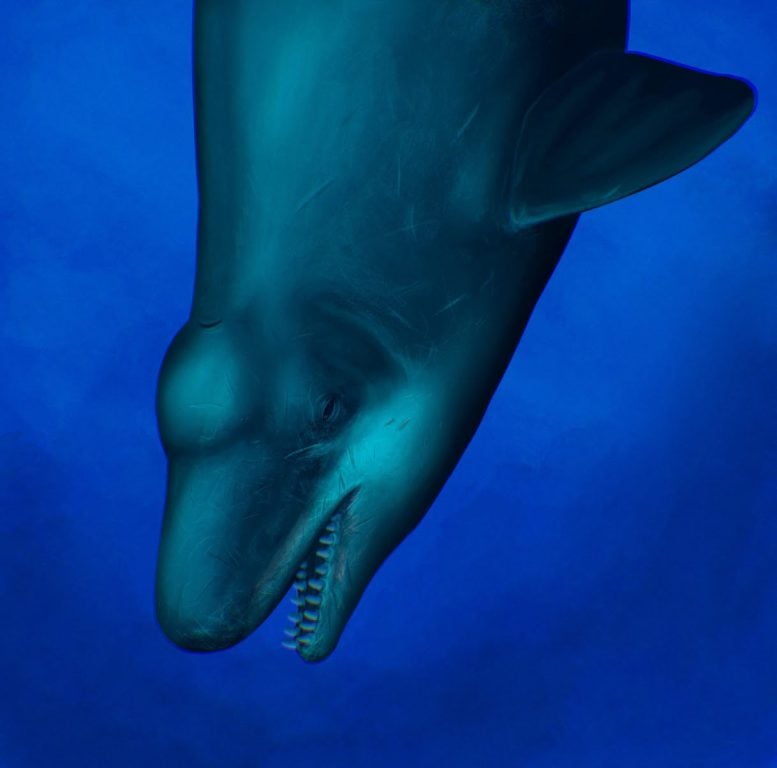
Researchers identified Scaphokogia huachafo, an extinct pygmy sperm whale that lived about 6.3 to 5.6 million years ago.
Its fossil skull was found in Peru’s Pisco Formation, a region known for well-preserved marine fossils.
Its nostrils and facial bones were shifted far to the left, making its skull unusually asymmetrical for a whale.
The whale was about 2.7 metres long, with a heavy snout that angled downward and a neck joint that let it lower its head.
These features suggest it searched for food near the seabed in shallow coastal waters, unlike modern sperm whales that hunt squid in deep water.
Researchers think it may have used echolocation to find prey hidden in soft sediment, but its hunting behavior is not directly known.
Its specialized habitat apparently disappeared as ocean conditions changed near the end of the Miocene.

Scientists identified Scaphokogia huachafo, an extinct pygmy sperm whale with the most extreme facial asymmetry documented in a cetacean.
Its skull had nostrils shifted entirely to the left and a snout that curved sharply downward.
The whale lived about 6.3 to 5.6 million years ago and measured about 2.7 meters long.
Its anatomy suggests it was adapted to search for food along the seabed in shallow coastal seas.
Researchers suspect it used biosonar to detect prey in soft seabed deposits, but say this is a hypothesis.
- Who
- Scaphokogia huachafo, an extinct pygmy sperm whale.
- What
- Scientists identified its skull as having the most extreme facial asymmetry documented in a cetacean.
- When
- About 6.3 to 5.6 million years ago.
- Where
- The fossil was recovered from the Pisco Formation in southern Peru.
- Why
- Its anatomy suggests it was adapted to search for food along the seabed; researchers suspect it used biosonar to detect prey.
This story does not have two clearly opposing sides.
Scaphokogia huachafo lived.
The skull was recovered from the Pisco Formation in southern Peru.
Aldo Benites-Palomino encountered the specimen while working on his bachelor’s thesis at the Museo de Historia Natural in Lima.
- Species
- Scaphokogia huachafo
- Age
- About 6.3 to 5.6 million years
- Length
- About 2.7 meters (8.9 feet)
- Snout angle
- Downward by 31 degrees
- Maximum head lowering
- As much as 55 degrees
- Fossil location
- Pisco Formation, southern Peru
What people are saying
Cranial asymmetry in toothed whales is directly linked to the development of fatty structures in the forehead that are involved in sound production. But in Scaphokogia huachafo, this asymmetry went far beyond the area around the blowhole. Both bony nostrils are shifted entirely to the left side of the skull, while the facial bones differ dramatically in size and position. The skull looks completely crooked
The entire cranio-cervical complex is modified to point the snout directly toward the bottom
The combination of dense bone, the downward-curving snout and the flexible neck articulation allowed the animal to move directly above the seabed and feed close to the sediment.