

Science & Tech · Science & Environment · 3 hrs ago
Amazon Wildfires Spread as Drought Fuels Smoke and Poor Air Quality
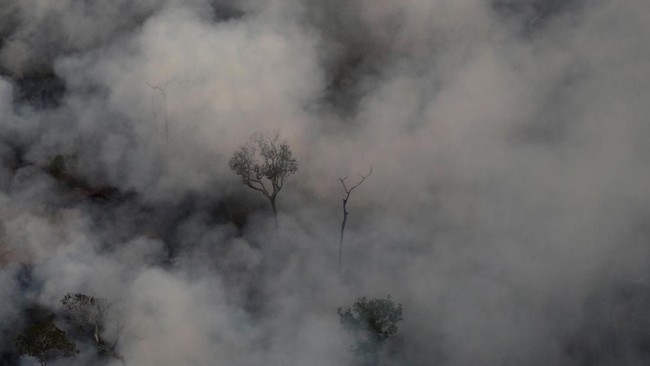
Wildfires are spreading across Brazil’s Amazon, where thick smoke is worsening air quality.
Extreme drought, intensified by El Niño, is making the forest more vulnerable to fire.
In Manaus, fine-particle pollution exceeded 135 micrograms per cubic meter, and schools, public activities and sports events were cancelled.
Many fires begin when people burn land for farming or pasture, but the flames can escape into dry forest.
A NASA scientist compared the fires to Indonesia’s recent wildfires, saying they are part of a recurring pattern seen in 2015–2016 and 2023.
Smoke, clouds and tree cover can hide fires from satellites, and one analysis found about 40% more fires near Santarém than the active-fire monitoring system detected.
More fires may reach northern Pará, Roraima, Amapá and neighboring countries in November and December, making the prevention of land burning especially important.

Wildfires are spreading across Brazil’s Amazon amid extreme drought worsened by El Niño.
Thick smoke is affecting several areas and worsening air quality.
In Manaus, PM2.5 concentrations exceeded 135 micrograms per cubic metre, and some schools, public activities and sports events were cancelled.
Brazil’s National Institute of Meteorology reported that Manaus rainfall was 95% below normal in August and 60% below normal in September.
A NASA scientist warned that more fires could affect parts of northern Brazil and neighbouring countries in November and December.
- Who
- Wildfires are affecting the Amazon in Brazil; NASA scientist Douglas Morton described the fires.
- What
- Fires are spreading and smoke is worsening air quality. In Manaus, PM2.5 exceeded 135 micrograms per cubic metre.
- When
- The article was published on October 18, 2026. A NASA satellite image dated October 12 showed smoke.
- Where
- The Amazon region of Brazil, including areas around Manaus, Santarém, Pará and Amazonas.
- Why
- Extreme drought, worsened by El Niño, has left forests more vulnerable. The article says most fires are caused by human activity.
This story does not have two clearly opposing sides.
Wildfires in Indonesia had begun, according to the article.
Rainfall in Manaus was 95% below normal.
Rainfall in Manaus was 60% below normal.
A NASA satellite image showed smoke from fires in the central and eastern Amazon, on both sides of the Amazon River.
Morton warned that another wave of fires could affect Roraima, northern Pará, Amapá, Venezuela, Guyana and Suriname.
- Manaus PM2.5
- More than 135 micrograms per cubic metre
- Manaus rainfall in August
- 95% below normal
- Manaus rainfall in September
- 60% below normal
- Uncontrolled fires near Santarém
- An estimated 50 to 70
- Fires missed by monitoring system
- About 40% more than detected by FIRMS
- Lightning contribution
- Less than 1% of fires are attributed to lightning
What people are saying
Now, in the Amazon, we are seeing the second domino in this sequence fall
This is striking and frustrating because it is happening again
With this intensity of El Niño, this year is truly a time for people to avoid burning at all costs