

Science & Tech · Space · 3 hrs ago
Millisecond Pulsar Found With a Very Young White Dwarf Companion
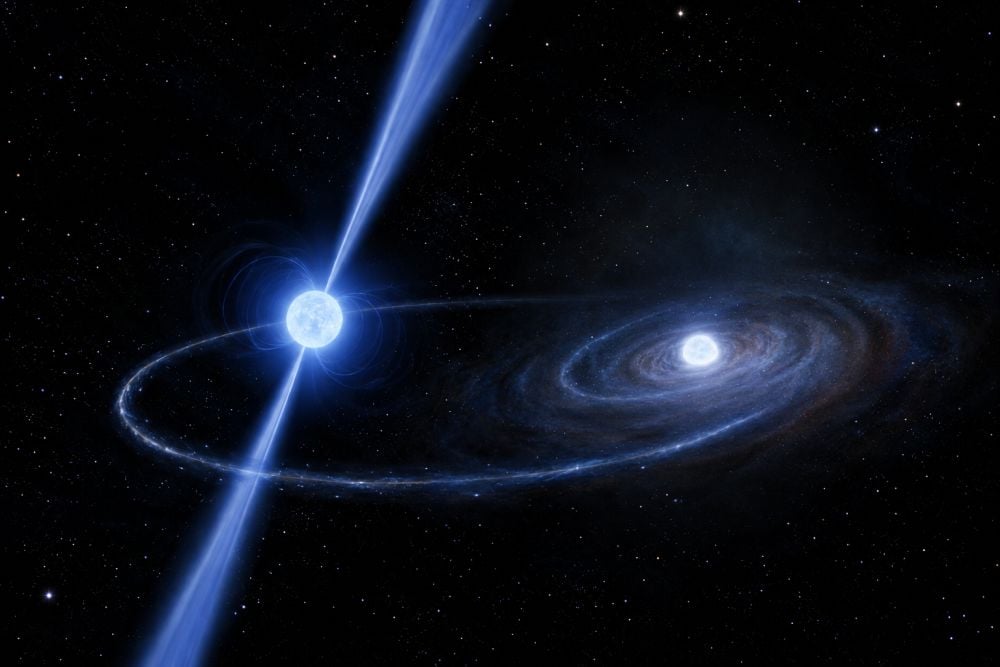
Researchers found a millisecond pulsar with a very young white dwarf companion in the globular cluster NGC 362.
The cluster is about 29,300 light-years from Earth, and the pulsar is called NGC362D.
A millisecond pulsar is a neutron star that spins extremely fast, and this one rotates once every 5.83 milliseconds.
Its white dwarf companion is at a rare stage of evolution, as the pulsar draws material away from it.
In this kind of pair, transferred material can add spin to the neutron star, helping explain how millisecond pulsars form.
The unusual pair offers a chance to study that process and the evolution of both stars.

Astronomers have identified a millisecond pulsar, NGC362D, with a very young white dwarf companion.
The pulsar is in the globular cluster NGC 362, about 29,300 light years away.
NGC362D has a rotation period of 5.83 milliseconds.
The research team includes scientists from Italy and Germany, and the study was published in Astronomy and Astrophysics.
- Who
- A team of researchers from Italy and Germany, with Greta Ettorre as the paper’s first author.
- What
- They studied NGC362D, a millisecond pulsar with a very young white dwarf companion.
- When
- NGC362D was discovered in December 2022. The article was published on November 9, 2026.
- Where
- The system is in the globular cluster NGC 362, about 29,300 light years away.
- Why
- The system offers insight into the evolution of millisecond pulsars and their companions.
This story does not have two clearly opposing sides.
NGC362D was discovered in the globular cluster NGC 362.
Universe Today published an article about research on NGC362D and its white dwarf companion.
- Pulsar
- NGC362D
- Rotation period
- 5.83 milliseconds
- Location
- Globular cluster NGC 362
- Distance
- About 29,300 light years
- First author
- Greta Ettorre
What people are saying
Millisecond pulsars (MSPs) form in binary systems containing a slowly rotating neutron star (NS) that is eventually spun up to millisecond periods by heavy-mass and angular-momentum transfer from an evolving companion