

Science & Tech · Science & Environment · 8 hrs ago
ETH Zurich Researchers Teach a Robotic Hand to Walk on Its Fingers
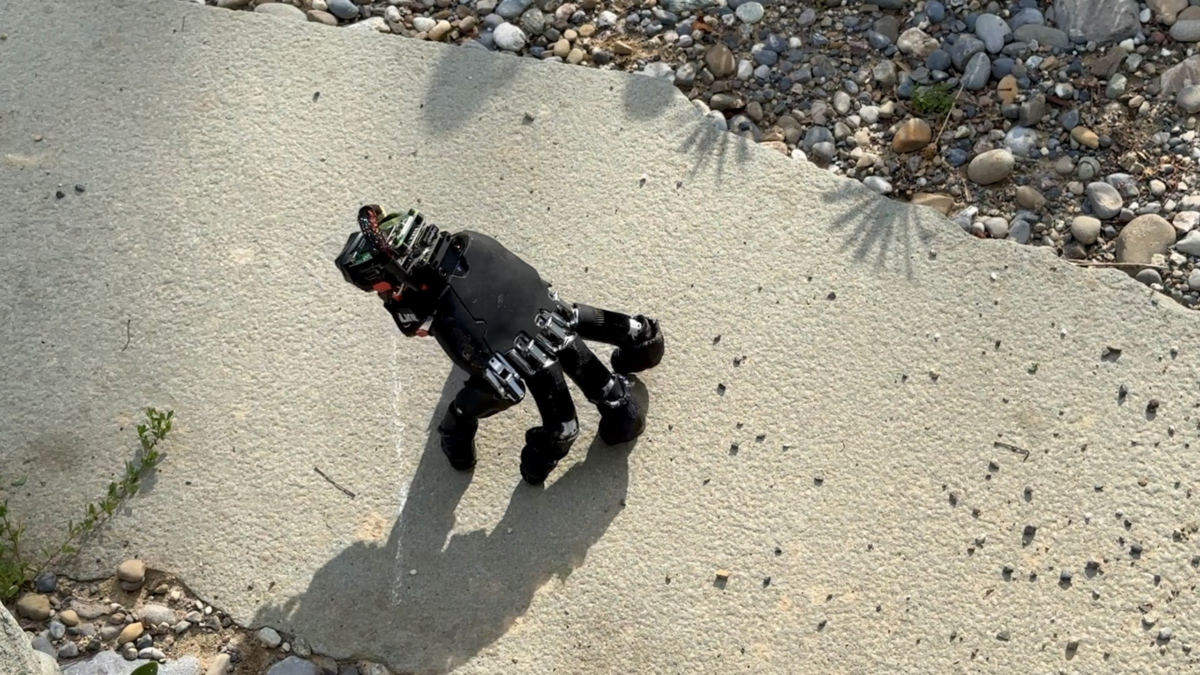
Researchers at ETH Zurich taught a robotic hand to walk on its fingertips and keep its balance.
The work explores whether a hand could enter spaces its robot body cannot reach to inspect things, operate controls or move objects.
The team added a battery, computer and motion sensor to a commercially available WUJI hand, then trained its control software in simulation.
In demonstrations, it crawled across 14 types of surfaces and averaged 9.3 centimetres per second in steering tests.
It also righted itself in 21 of 25 trials and pressed a keyboard arrow key while balancing on its other fingers.
The study is a preprint that has not yet been peer-reviewed, and it shows an early approach to giving robotic hands more independent movement.

ETH Zurich researchers taught a robotic hand to walk on its fingertips while carrying its own battery and computer.
The hand also learned to get upright after falling and press keyboard keys while balancing on its other fingers.
The team trained its control software in simulation before adapting it to the physical hand.
In demonstrations, the hand crawled over 14 surfaces, and it averaged 9.3 centimeters per second in steering tests.
The study was posted as a preprint on arXiv and has not yet been peer-reviewed.
- Who
- Researchers at ETH Zurich, including first author and doctoral researcher Amirhossein Kazemipour.
- What
- They trained a robotic hand to walk on its fingertips, recover after a fall and press keyboard keys while balancing.
- When
- ScienceAlert published the report on November 8, 2026. The demonstrations’ dates are not stated.
- Where
- ETH Zurich in Switzerland; demonstrations included outdoor surfaces and a mat.
- Why
- To enable a robot to send its hand into spaces its body cannot enter to inspect something, operate a control or move an object.
This story does not have two clearly opposing sides.
The researchers trained the hand’s control software in simulation using reinforcement learning.
The team adapted the movements to the real hand by measuring its joint responses and fingertip sliding.
The hand crawled over 14 surfaces, including wooden floors, metal grating, grass and gravel.
The hand averaged 9.3 centimeters per second across 21 runs and succeeded in righting itself in 21 of 25 trials.
- Hand model
- WUJI robotic hand
- Complete setup weight
- 818 grams, or about 1.8 pounds
- Surfaces crossed
- 14
- Steering speed
- 9.3 centimeters per second across 21 runs
- Righting trials
- 21 successes in 25 physical trials
1 source
What people are saying
A future robot could send its hand into a space its body cannot enter, to inspect something, operate a control or move an object, then retrieve it afterward,
The fingers have different lengths and a thumb off to one side, which makes walking awkward,
The key was tailoring the training to the hand's shape and carefully matching the simulation to the real hardware,