

Science & Tech · Science & Environment · 4 hrs ago
A Low-Mass Star Is Slowly Feeding on Its Brown Dwarf Companion
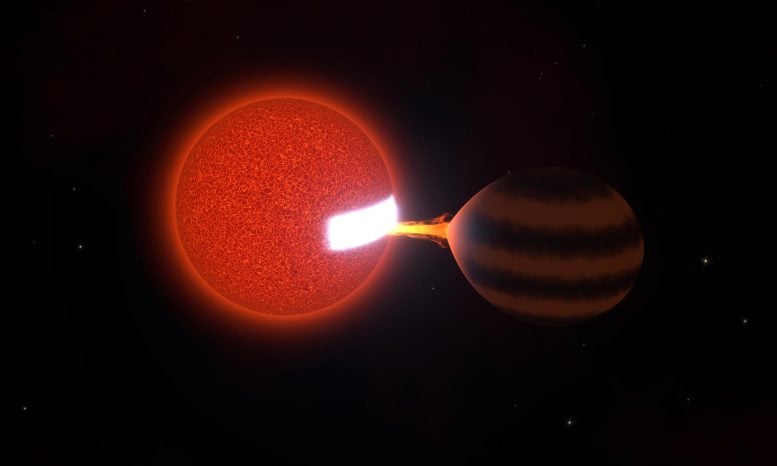
Astronomers found a star slowly drawing material from its companion in a system about 300 light-years from Earth, within the Milky Way.
The system, called ZTF J0440+2325, contains a brown dwarf and a low-mass star that orbit each other every 86.65 minutes.
A brown dwarf is an object between a planet and a star in mass; this one has about 25 times Jupiter’s mass, while its companion has about 85 times Jupiter’s mass.
Material flows from the brown dwarf onto the star, where it strikes the surface and creates a hot spot.
Unlike cases where a star rapidly engulfs a nearby planet, this is the first observed slow, steady feeding between low-mass objects.
The transfer could continue for hundreds of thousands or even billions of years, according to the researchers.

Astronomers report the first observed case of a low-mass star slowly consuming material from another low-mass object.
The system, ZTF J0440+2325, is about 300 light-years from Earth in the Milky Way.
Its brown dwarf companion overflows onto the red dwarf, with material striking the star and heating a hot spot.
The objects orbit each other every 86.65 minutes, and the slow feeding could continue for hundreds of thousands or even billions of years.
The discovery was reported in a paper published in Nature Astronomy on October 5, 2026.
- Who
- Astronomers at MIT and other institutions studied the system. The objects are a red dwarf and a brown dwarf.
- What
- The red dwarf is slowly drawing material from its brown dwarf companion.
- When
- The paper was published October 5, 2026.
- Where
- ZTF J0440+2325 is in the Milky Way, about 300 light-years from Earth.
- Why
- The brown dwarf overflows onto the red dwarf, and material strikes the star’s surface.
This story does not have two clearly opposing sides.
Kevin Burdge noticed an unusual repeating triangular brightness pattern in data from the Zwicky Transient Facility.
Burdge and graduate student Aaron Householder returned to the unexplained signal and directed multiple telescopes toward its source.
The discovery was reported in a paper published in Nature Astronomy.
- System
- ZTF J0440+2325
- Distance
- About 300 light-years from Earth
- Orbital period
- 86.65 minutes
- Brown dwarf mass
- About 25 times Jupiter’s mass
- Red dwarf mass
- About 85 times Jupiter’s mass
What people are saying
I remember first looking at this and thinking, stars don’t make triangular waveforms like this
We weren’t seeing that whipping back and forth here
It didn’t make any sense. We couldn’t explain what this was
If you have less mass in the system overall, things can gently orbit each other without whipping back and forth