

Science & Tech · Science & Environment · 3 hrs ago
Ashmolean projects ancient colors onto King Taharqa’s shrine
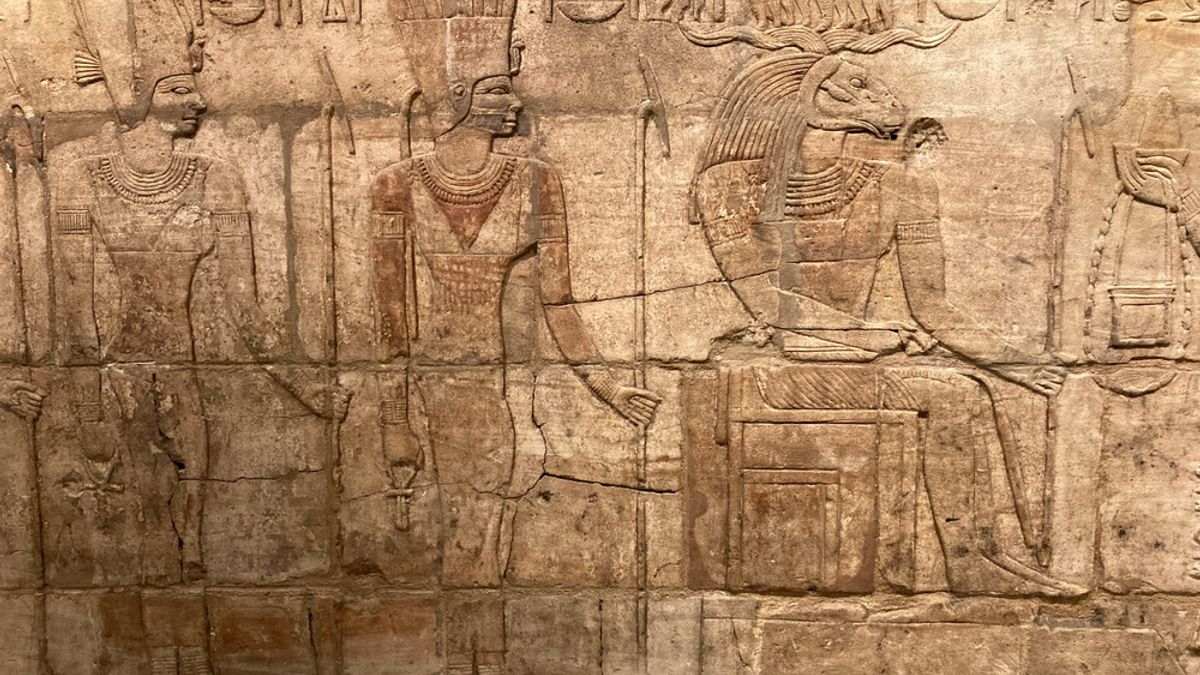
The Ashmolean Museum is projecting colors onto an ancient shrine to show visitors how it may have looked when new.
The 13-foot-square structure was made for King Taharqa, whose realm included Egypt and Kush, in what is now Sudan.
Today its sandstone looks bare, but its walls were once painted pink, with blue, red and yellow details.
Infrared images revealed blue paint on the god Amun-Re and some sacred details, suggesting painters reserved the pigment for important imagery.
Researchers combined pigment tests, imaging and a 3D scan to rebuild the shrine’s appearance, using similar temple paintings to fill gaps.
Some projected colors are informed guesses, because much of the original paint is gone and no one knows what the shrine once held.
The permanent display lets visitors see the reconstruction on the carved stone.

The Ashmolean Museum has made a permanent display projecting reconstructed colors onto the Shrine of King Taharqa.
The 13-foot-square shrine was originally painted, but now appears to be bare stone.
Researchers used pigment analysis and imaging to identify colors and map where they appeared.
The projection combines recovered evidence with educated reconstruction where paint is missing.
The shrine was made for King Taharqa and stood in a temple at Kawa, in what is now Sudan.
- Who
- The Ashmolean Museum created the display, drawing on research by several researchers.
- What
- A permanent projection shows reconstructed colors on the Shrine of King Taharqa.
- When
- The display has now been made permanent. The shrine arrived at the museum in 1936.
- Where
- At the Ashmolean Museum; the shrine originally stood in a temple at Kawa, in what is now Sudan.
- Why
- To help visitors appreciate and understand the shrine’s original painted decoration.
This story does not have two clearly opposing sides.
Microscope work on surviving paint flecks revealed which pigments had been used.
Caroline Armstrong’s infrared images showed where blue paint had been applied.
Ian Maybury mapped the shrine’s other colors using imaging and X-ray analysis.
The Ashmolean Museum made a permanent display projecting reconstructed colors onto the shrine.
- Shrine dimensions
- 13-foot-square
- Arrival at museum
- 1936
- Pigment analysis
- Microscope work in 1990 identified pigments in surviving paint flecks.
- Infrared imaging
- Caroline Armstrong’s 2013 images revealed where blue had been used.
- Color mapping
- Ian Maybury mapped other colors in 2019.
What people are saying
This exceptional monument offers a fascinating insight into the art and archaeology of ancient Sudan. The new projection – and the scientific research behind it — will allow visitors to appreciate and understand the Shrine’s original painted decoration like never before,