

Science & Tech · Space · 1 hr ago
Lumina simulation recreates the universe’s first 2 billion years
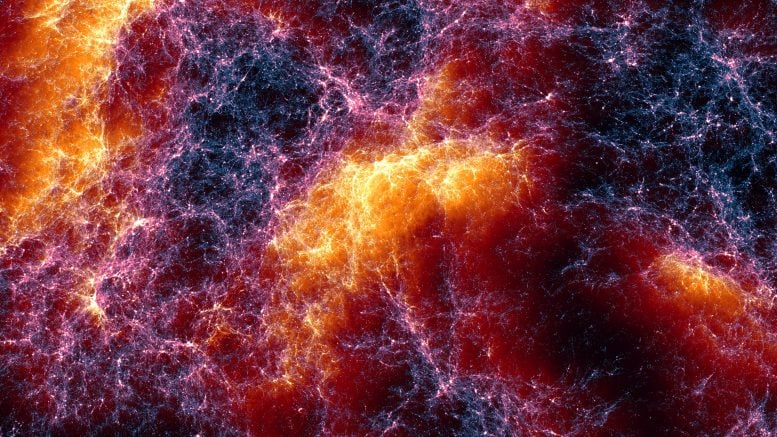
Researchers at the Center for Astrophysics | Harvard & Smithsonian created Lumina, a computer simulation of the early universe.
It follows the first 2 billion years of cosmic history, showing how young galaxies formed and changed their surroundings.
The model calculates how ordinary matter, dark matter and radiation shaped the developing cosmos.
Dark matter cannot be seen directly, but its gravity helps form galaxies and larger structures.
Scientists can use the simulation as a virtual laboratory to test theories by comparing its results with what telescopes observe.
Differences could point to missing pieces in our understanding of cosmic history.
Researchers can compare Lumina’s predictions with observations from the James Webb Space Telescope and the Nancy Roman Space Telescope.

Researchers at the Center for Astrophysics | Harvard & Smithsonian developed Lumina, a simulation of the universe’s first 2 billion years.
The simulation models interactions between ordinary matter, dark matter and radiation.
It lets researchers examine how early stars and galaxies formed and how radiation changed the young cosmos.
Scientists can compare its predictions with observations from the James Webb Space Telescope and the Nancy Roman Space Telescope.
The research was published in Monthly Notices of the Royal Astronomical Society.
- Who
- Researchers at the Center for Astrophysics | Harvard & Smithsonian developed the simulation.
- What
- Lumina recreates the universe’s first 2 billion years, modeling how matter and radiation interacted.
- When
- It covers the first 2 billion years of cosmic history. The article was published on November 9, 2026.
- Where
- In a virtual universe described as 1.5 billion light-years across.
- Why
- To investigate how early stars and galaxies formed and test theories of the young universe against telescope observations.
This story does not have two clearly opposing sides.
Researchers developed Lumina to model the first 2 billion years of cosmic history.
The research was reported as published in Monthly Notices of the Royal Astronomical Society.
- Simulation
- Lumina
- Cosmic period modeled
- First 2 billion years
- Simulation scale
- 1.5 billion light-years across
- Lead author
- Oliver Zier
- Research journal
- Monthly Notices of the Royal Astronomical Society
What people are saying
SciTechDaily | With JWST, the early universe has become an exciting new frontier in astrophysics
SciTechDaily | To understand what we are seeing with this telescope, we need to translate our theories into detailed predictions.