

Science & Tech · Space · 2 hrs ago
May 2024 Solar Storm Boosted Electrons Inside Earth’s Radiation Barrier
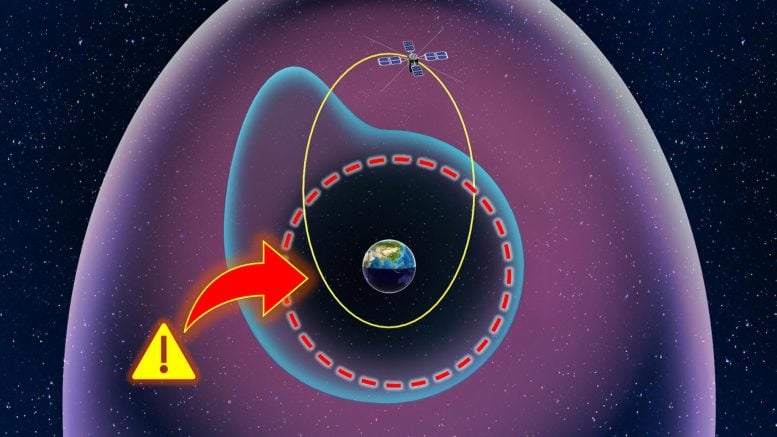
A May 2024 solar superstorm changed conditions around Earth, and Japan’s Arase spacecraft detected large numbers of highly energetic electrons inside a region usually thought to keep them out.
The region lies near the inner edge of the outer Van Allen radiation belt, where Earth’s magnetic field traps charged particles.
Some electrons had energies above three megaelectronvolts, enough to penetrate some satellite shielding.
Researchers think the electrons gained energy inside the region, rather than arriving already highly energized from farther out.
The storm thinned the surrounding plasma, allowing hotter electrons to reach farther inward and produce chorus waves that can transfer energy to electrons.
The low-density conditions lasted several days, giving the waves time to keep accelerating particles.
This means radiation hazards can develop inside a supposedly protected region, so understanding the process matters for spacecraft safety.

During the May 2024 geomagnetic superstorm, Arase detected highly energetic electrons inside a region near Earth that usually excludes them.
Some electrons had energies exceeding three megaelectronvolts, enough to pass through some satellite shielding.
Researchers led by Nagoya University say the evidence suggests the electrons gained energy locally rather than arriving from the outer radiation belt.
The storm eroded the plasmasphere, allowing chorus waves to form and potentially accelerate electrons for several days.
- Who
- Arase, a space probe operated by JAXA, detected the electrons. Researchers led by Nagoya University analyzed the observations.
- What
- Highly energetic electrons were detected inside a region that normally excludes them.
- When
- During and after the geomagnetic superstorm of May 2024.
- Where
- Inside the usual electron barrier near Earth, at the inner edge of the outer Van Allen radiation belt.
- Why
- The evidence suggests chorus waves accelerated the electrons locally after the storm eroded the plasmasphere.
This story does not have two clearly opposing sides.
A geomagnetic superstorm eroded the plasmasphere and brought northern lights to parts of Japan.
Arase detected highly energetic electrons inside the usual electron barrier.
Researchers led by Nagoya University analyzed how the electrons appeared in the region.
SciTechDaily published its report on the findings.
- Electron energy
- Some exceeded three megaelectronvolts
- Probe
- Arase, operated by JAXA
- Study lead
- Yoshizumi Miyoshi of Nagoya University
- Plasmasphere recovery
- 4.3 to 4.7 days to recover to more than half of its pre-storm density in the observed region
- Usual barrier location
- Roughly three times Earth’s radius from the planet’s center
What people are saying
One of the key questions was how these highly energetic electrons appeared inside the barrier. Were they transported inward from the outer radiation belt, or were they accelerated locally within this region?
Typically, the plasmasphere recovers on a timescale of about two days. During the May 2024 superstorm, however, it took approximately 4.3 to 4.7 days for the plasma density to recover to more than half of its pre-storm level in the observed region.