

Science & Tech · Science & Environment · 3 hrs ago
New survey estimates nearly 183,000 giant tortoises on Aldabra
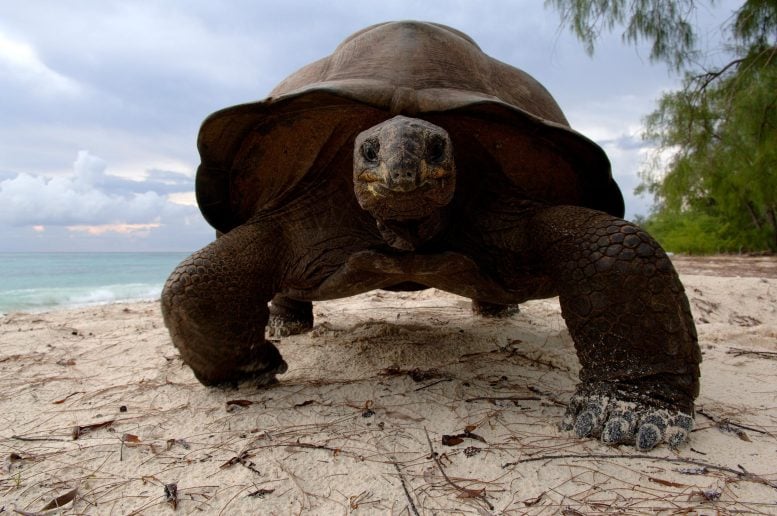
Researchers estimate nearly 183,000 giant tortoises live on Aldabra Atoll in Seychelles, the largest free-roaming population of the species.
The estimate covers adult and subadult animals and is higher than the widely quoted figure of about 100,000 from the late 1990s.
The population appeared relatively stable from 2018 to 2022, the period covered by monitoring data collected by Seychelles Islands Foundation staff.
The higher estimate does not mean the tortoise population nearly doubled: earlier counts likely missed animals hidden by vegetation and shade.
Researchers used a statistical method that accounts for animals observers could not see, creating a more reliable baseline for future monitoring.
Decades of protection helped the tortoises recover after heavy exploitation reduced their numbers to fewer than 1,000 in the 19th century; Aldabra became a strict nature reserve in 1981 and a UNESCO World Heritage Site in 1982.
Longer, more frequent droughts could threaten the population by reducing food, while the new baseline will help researchers track changes over the coming decades.

A new survey estimates nearly 183,000 adult and subadult Aldabra giant tortoises on Aldabra Atoll in Seychelles.
The estimate is the first rigorous population estimate covering the atoll and replaces a widely quoted figure of about 100,000 from the late 1990s.
Researchers say the tortoise population appeared relatively stable from 2018 through 2022.
The estimate accounts for tortoises that observers did not see, especially in dense vegetation.
The population has recovered from fewer than 1,000 tortoises in the 19th century, but droughts are among the environmental pressures it faces.
- Who
- Aldabra giant tortoises; the research was led by the Seychelles Islands Foundation and the University of Exeter.
- What
- A survey estimated nearly 183,000 adult and subadult tortoises on Aldabra Atoll.
- When
- Monitoring records collected from 2018 through 2022 were analyzed. The study was published in 2026.
- Where
- Aldabra Atoll, Seychelles.
- Why
- The survey aimed to estimate the population more reliably by accounting for tortoises that observers failed to detect.
This story does not have two clearly opposing sides.
Heavy exploitation reduced Aldabra’s tortoise population to fewer than 1,000.
Aldabra was designated a strict nature reserve.
Aldabra was designated a UNESCO World Heritage Site.
Seychelles Islands Foundation staff collected the monitoring records analyzed in the study.
The study was published in Ecology and Evolution.
- Best estimate
- Almost 183,000 adult and subadult tortoises
- Older widely quoted estimate
- About 100,000 tortoises, from the late 1990s
- Monitoring period
- 2018–2022
- Research leads
- Seychelles Islands Foundation and University of Exeter
- Highest-density habitat
- Grasslands known as “tortoise turf
What people are saying
More than 180,000 giant tortoises roaming freely on our atoll is proof of what long-term commitment to conservation can achieve.
By modeling what we didn’t see, as well as what we did, we’ve produced the most reliable baseline yet for this iconic Seychelles species, establishing a benchmark we can use to track the population for decades to come.