

Science & Tech · Space · 8 hrs ago
Repeated Star Collisions Could Help Explain Early Black Holes
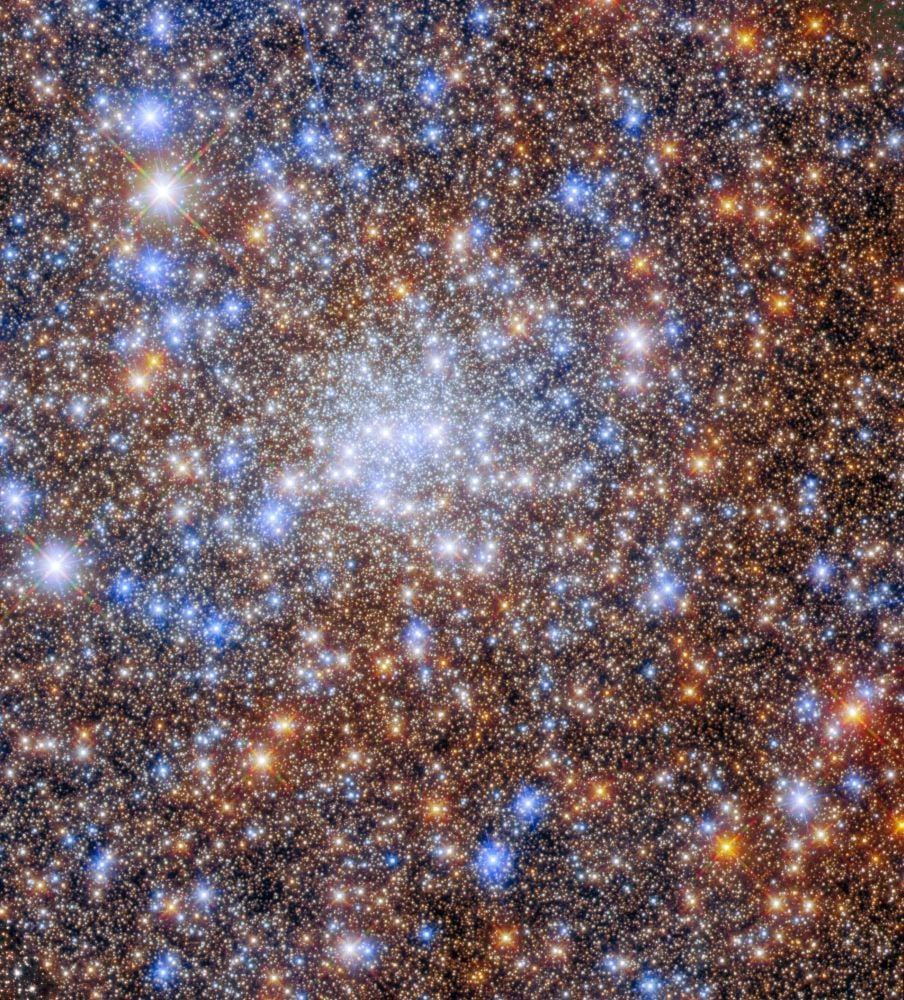
JWST has found supermassive black holes dating from just 400 million to 500 million years after the Big Bang, earlier than current theories readily explain.
Researchers propose repeated collisions between stars in dense clusters in the early Universe as one possible explanation.
Their simulations used conditions based on cosmological simulations and JWST observations of early star clusters and galaxies.
In some simulated clusters, stars merged again and again, building a very massive star that could weigh as much as the whole cluster.
Models suggest that when such a star reaches the end of its life, it may collapse into a black hole.
The idea offers a possible route to early black holes, but it is not yet a widely accepted explanation.
The researchers' work was published in The Astrophysical Journal, and further study will be needed to test the proposal.

Researchers say repeated collisions between stars in dense early-Universe clusters could have produced very massive stars that later collapsed into black holes.
The idea may help explain why the James Webb Space Telescope detected supermassive black holes just 400 million and 500 million years after the Big Bang.
A study led by UCLA doctoral student Claire Williams used simulations of early star-cluster environments.
The simulations found that repeated collisions could create a star more massive than 100 Suns, potentially as massive as its entire cluster.
The research was published in The Astrophysical Journal.
- Who
- Researchers led by Claire Williams, a doctoral student at UCLA.
- What
- They studied whether repeated stellar collisions could produce very massive stars that collapse into black holes.
- When
- The study was published on October 27, 2026. The black holes it seeks to explain were observed 400 million and 500 million years after the Big Bang.
- Where
- The proposed collisions occur in dense stellar systems in the early Universe.
- Why
- To explore a possible explanation for supermassive black holes found earlier than existing theory predicts.
This story does not have two clearly opposing sides.
The study was published in The Astrophysical Journal.
Researchers simulated environments with 1,000 stars in each test case, located within 1 parsec of the center.
The team found that repeated collisions could form very massive stars, potentially as massive as an entire cluster.
- Study lead
- Claire Williams, UCLA
- Publication
- The Astrophysical Journal
- Stars per test case
- 1,000
- Starting distance from cluster center
- Within 1 parsec
- Possible very massive star threshold
- Above 100 solar masses is often used
- Early black-hole observations
- 400 million and 500 million years after the Big Bang
What people are saying
Perhaps the strangest outcome of our simulations is that stars can merge repeatedly within the cluster until they form one gigantic star with a mass equal to that of an entire cluster.
When a star this huge reaches the end of its life, models suggest that it may have no option but to collapse into itself and form a massive black hole.
Observations and cosmological simulations indicate that the early Universe hosted numerous compact, high-density stellar systems, where close encounters and physical collisions between stars were likely common.