

Business · Energy & Commodities · 3 hrs ago
Brazil names 27 critical minerals and plans reviews of some sales contracts
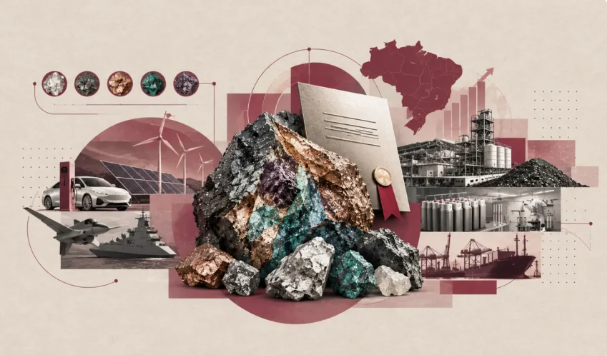
Brazil’s government has named 27 minerals as critical and strategic after the first meeting of a national council in Brasília.
The minerals are divided into three classes based on priority, using factors such as geopolitical risk, supply concentration and Brazil’s place in the supply chain.
For minerals in the high- and medium-priority classes, the government may review ownership and sales contracts.
For the low-priority class, it may review ownership, but not sales contracts.
Only projects focused on the listed minerals and included in a national register can receive government support provided for by law.
That support may include access to a fund that shares risks in bank lending, addressing a challenge in financing early-stage mining and exploration.
The council is due to meet again around late November or early December to discuss a national plan for critical minerals and related industrial supply chains.

Brazil has named 27 minerals as critical and strategic, dividing them into three levels of priority for government support.
The classification can lead to reviews of ownership control and sales contracts for minerals in the higher-priority groups.
The government says the ranking will help strengthen industrialisation and national sovereignty.
The first meeting of the National Council for the Industrialisation of Critical and Strategic Minerals took place in Brasília on November 5.
A second council meeting, expected around the turn of November to December, is to discuss a national plan for the minerals.
- Who
- Brazil’s government and its National Council for the Industrialisation of Critical and Strategic Minerals.
- What
- The government named 27 critical and strategic minerals and assigned them to three priority groups. Some groups may face reviews of ownership control and sales contracts.
- When
- The list was announced on November 5, 2026. The decree setting out the rules was published on November 4.
- Where
- Brasília, Brazil.
- Why
- The priority system is intended to guide government support and strengthen industrialisation and national sovereignty, taking account of factors including geopolitical risk and supply dependence.
This story does not have two clearly opposing sides.
Minister Márcio Elias Rosa said at a seminar in the Chamber of Deputies that the government would give absolute priority to implementing the national minerals policy.
A decree signed by President Luiz Inácio Lula da Silva and Mines and Energy Minister Alexandre Silveira was published in an extra edition of the Official Gazette.
The minerals council held its first meeting in Brasília, and the government announced the initial list of 27 minerals.
The council’s next meeting is expected to discuss the National Plan for Critical and Strategic Minerals.
- Total minerals
- 27
- Priority groups
- Three
- Class I
- High priority; includes rare earths, graphite, lithium, nickel, cobalt, copper, manganese, silicon and uranium
- Class II
- Medium priority; includes tungsten, chromium, vanadium, tantalum, titanium, phosphate, potash and sulfur
- Class III
- Low priority; includes niobium, tin, iron, zinc, gold, magnesium, molybdenum, thorium, aluminium and platinum group
- Next council meeting
- Expected around the turn of November to December
2 sources
What people are saying
Há prioridade absoluta para esse tema
O valor não está na quantidade. Está na capacidade de agregação. Ele existe muito mais em razão do que é capaz de gerar do que do simples valor de lavra.