

Politics · United States · 2 hrs ago
Supreme Court allows New Hampshire to ban student IDs for voting
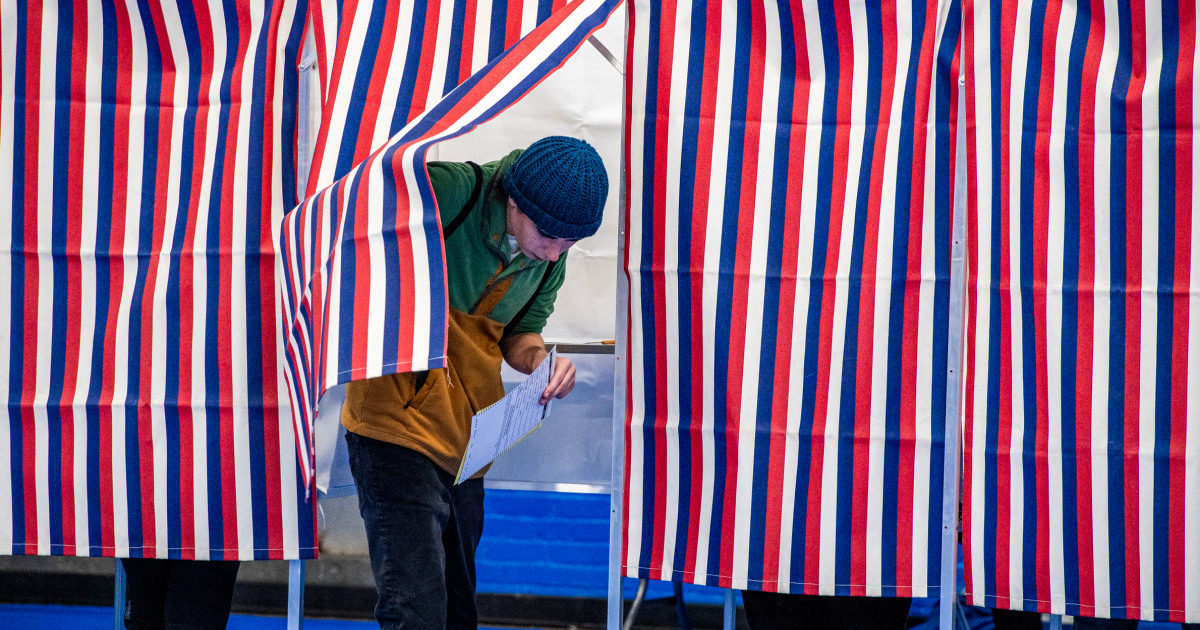
The Supreme Court cleared the way for New Hampshire to ban student IDs as backup voter identification in the midterm elections.
A state law passed this year stopped listing student IDs as an accepted form of identification, and the secretary of state also barred their use as a backup.
A judge left the law in place but blocked the secretary of state’s guidance, leading the state to appeal.
The Supreme Court relied on a principle that says courts should generally avoid changing election rules close to an election.
Justice Ketanji Brown Jackson dissented, saying that principle might not apply because the lower court had left the state law unchanged.
The ruling comes less than two weeks before New Hampshire voters cast ballots, including in a closely contested U.S. Senate race.

The Supreme Court allowed New Hampshire to bar student IDs as a backup way to verify voters’ identities in the November midterm elections.
The unsigned order granted the state’s emergency request and invoked the Purcell principle against changing election rules close to an election.
The dispute concerned whether election officials could consider a student ID alongside other evidence when a voter sought to prove their identity.
Justice Ketanji Brown Jackson was the sole publicly identified dissenter, questioning whether the principle applied.
The ruling came less than two weeks before New Hampshire voters were due to cast ballots in a closely watched Senate race.
- Who
- The U.S. Supreme Court ruled on New Hampshire’s emergency request, backed by the Republican National Committee.
- What
- The court allowed the state to bar student IDs as a backup means of verifying voter identity.
- When
- Thursday, October 22, 2026, less than two weeks before the midterm election.
- Where
- New Hampshire.
- Why
- The court said the lower court had not justified changing election rules so close to the election, invoking the Purcell principle.
New Hampshire officials and the Republican National Committee
Coalition for Open Democracy and the plaintiffs
Policy
New Hampshire officials and the Republican National Committee
Officials said student IDs should not be used to establish identity when requesting a ballot, including as a backup.
Coalition for Open Democracy and the plaintiffs
The plaintiffs challenged that interpretation, arguing student IDs could be considered with other evidence.
Court ruling
New Hampshire officials and the Republican National Committee
The state sought to reinstate its interpretation after a lower court blocked it.
Coalition for Open Democracy and the plaintiffs
The plaintiffs’ lawyers said the Supreme Court ruling would confuse voters and deprive young voters of their voting rights.
Legal basis
New Hampshire officials and the Republican National Committee
The Supreme Court relied on the Purcell principle against changing election rules close to an election.
Coalition for Open Democracy and the plaintiffs
Justice Ketanji Brown Jackson said the lower court had left the state law untouched and questioned applying Purcell to the case.
New Hampshire enacted a law removing student IDs from the list of accepted primary forms of voter identification.
A federal district court blocked the secretary of state’s guidance barring student IDs as a backup means of identification.
The 1st U.S. Circuit Court of Appeals declined to put the district court’s ruling on hold, and the state asked the Supreme Court to intervene.
The Supreme Court granted the state’s emergency request and allowed New Hampshire to bar student IDs as backup identification.
New Hampshire’s midterm election was scheduled to take place.
- Supreme Court order
- October 22, 2026
- State
- New Hampshire
- Identification affected
- Student IDs used as backup evidence of voter identity
- Dissent
- Justice Ketanji Brown Jackson was the sole publicly identified dissenter
- Senate race
- Republican John E. Sununu faced Democrat Chris Pappas for the seat held by Jeanne Shaheen
4 sources
What people are saying
New Hampshire has a responsibility to protect the integrity of its elections and ensure that election laws are applied as written.
I respectfully dissent because – even, and perhaps especially, when an election is looming – I would not disturb a clearly justifiable federal-court order issued to ensure that the public receives accurate information about a state’s electoral processes.
injecting confusion into the election—precisely what the Purcell principle is supposed to prevent—and authorizing an unconstitutional policy that will deprive young voters of their right to vote.
Here, the District Court did not point to anything that would justify deviating from that principle,