

Science & Tech · Space · 2 hrs ago
Astronomers spot a possible dwarf planet beyond Pluto
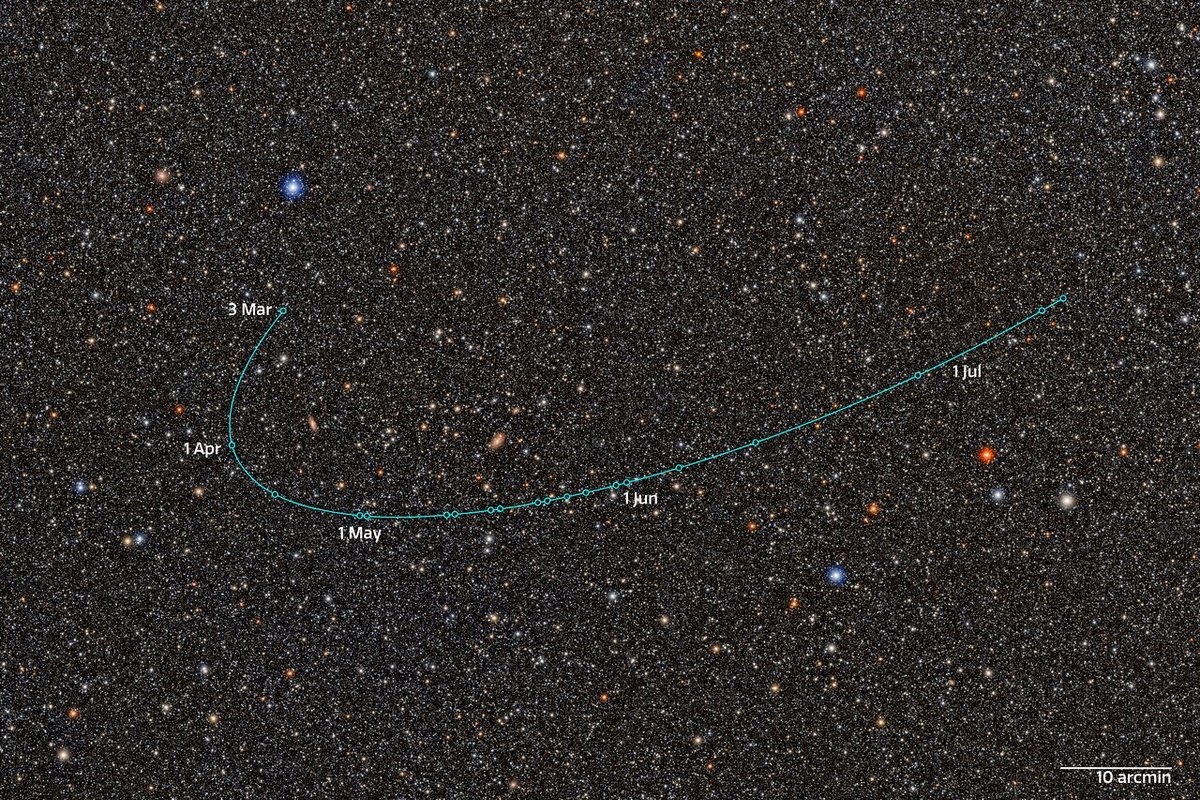
Astronomers have found a possible dwarf planet beyond Pluto using the Vera C. Rubin Observatory in Chile.
The object is provisionally named 2026 ED138 and has not yet received an official name.
It lies about 46 times farther from the Sun than Earth, farther out than Pluto, and is tilted about 25 degrees from the solar system’s main plane.
Early estimates put its diameter at 600 to 1,500 kilometers, making it one of the largest dwarf planet candidates found so far.
To qualify as a dwarf planet, it must be massive enough for its own gravity to pull it into a round shape, which still needs to be checked.
More observations will determine whether it qualifies and help astronomers map its orbit.
The observatory plans to scan the southern sky repeatedly over ten years, which could reveal other distant objects that earlier searches missed.

Astronomers at the Vera C. Rubin Observatory have identified 2026 ED138 as a possible dwarf planet beyond Pluto’s orbit.
The object is about 46 times as far from the Sun as Earth and is more distant than Pluto.
Initial measurements put its diameter between 600 and 1,500 kilometers, but more observations are needed to determine whether it is round enough to qualify as a dwarf planet.
The object was difficult to detect because its light was obscured by stars in the Milky Way.
- Who
- Astronomers at the Vera C. Rubin Observatory, including Matthew Holman and Mario Jurić, identified the candidate.
- What
- They found 2026 ED138, a trans-Neptunian object considered a possible dwarf planet.
- When
- The discovery was announced on Tuesday, October 27, 2026.
- Where
- Beyond Neptune’s orbit, in the outer solar system. The Rubin Observatory is in Chile.
- Why
- The object was identified after Rubin data were searched with code developed by astronomers. Its light had been obscured by stars in the Milky Way.
This story does not have two clearly opposing sides.
Earlier observations of 2026 ED138 were found in data from other observation tools.
Rubin recorded 30 additional observations of the object.
Astronomers announced 2026 ED138 as a dwarf planet candidate.
- Provisional designation
- 2026 ED138
- Distance from the Sun
- About 46 times Earth’s distance
- Estimated diameter
- 600–1,500 kilometers
- Orbital tilt
- Around 25 degrees off the solar system’s plane
- Observatory
- Vera C. Rubin Observatory in Chile
3 sources
What people are saying
My first reaction was one of excited disbelief,
If confirmed as a dwarf planet, ED138 would join a very small family of worlds,