

Business · Companies · 5 hrs ago
Oracle targets $225 billion or more in revenue by fiscal 2030
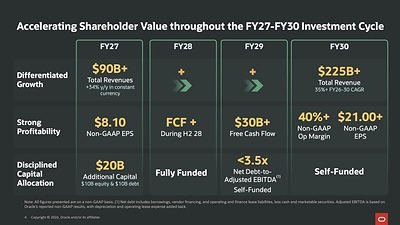
Oracle set a target of at least $225 billion in fiscal 2030 revenue, outlining its financial plans at an investor event in Las Vegas.
The company expects revenue to grow by more than 35% a year on average from fiscal 2026 through fiscal 2030.
It expects free cash flow to turn positive in the second half of fiscal 2028, after a period of high capital spending in fiscal 2027 and 2028.
Oracle is targeting at least $30 billion in free cash flow in fiscal 2029, when it says growth will become self-funded.
Oracle plans to limit additional market funding to $20 billion through fiscal 2030, split between equity and gross debt, not counting debt refinancing.
It also expects net debt to adjusted EBITDA to fall below 3.5 times in fiscal 2029.
The targets matter because they link Oracle's AI-related investment cycle to a plan for stronger cash generation, while the company reaffirmed its fiscal 2027 revenue and earnings outlook.

Oracle said it expects revenue of at least $225 billion in fiscal 2030, as it outlined plans for growth driven by demand for AI and cloud services.
The company expects capital spending to peak in fiscal 2027 and 2028, then decline in fiscal 2029.
Oracle expects free cash flow to turn positive in the second half of fiscal 2028 and reach at least $30 billion in fiscal 2029.
It committed to limiting additional capital raises for its fiscal 2027–2030 investment cycle to $20 billion, excluding refinancing of existing debt.
Oracle said it expects growth to be self-funded from fiscal 2029.
- Who
- Oracle, the US software and data-centre company.
- What
- Oracle forecast fiscal 2030 revenue of at least $225 billion and said it expects positive free cash flow from the second half of fiscal 2028.
- When
- The company announced the outlook on October 28, 2026. The revenue target is for fiscal 2030.
- Where
- Oracle’s investor day was held in Las Vegas, Nevada.
- Why
- Oracle said its cloud infrastructure, database and applications businesses are expected to drive growth. The company also aims to reduce reliance on outside funding as its capital spending declines.
This story does not have two clearly opposing sides.
Oracle expects capital spending to peak as it builds cloud-computing capacity.
Oracle expects free cash flow to turn positive.
Oracle expects capital spending to decline, free cash flow to reach at least $30 billion and growth to become self-funded.
Oracle expects total revenue of at least $225 billion.
- Fiscal 2030 revenue
- At least $225 billion
- Fiscal 2030 adjusted earnings per share
- More than $21
- Fiscal 2029 free cash flow
- At least $30 billion
- Additional capital raises through fiscal 2030
- $20 billion, split between $10 billion in equity and $10 billion in gross debt
- Fiscal 2027 revenue outlook
- At least $90 billion
4 sources
What people are saying
I’ve told you we need an additional up to US$20-billion in funding for the remainder of our fiscal 2027
We’re announcing that this US$20-billion, split evenly between debt and equity, is the final amount needed to fund the remainder of this cycle
Oracle is trying to show investors that there’s a method to the madness of its massive AI infrastructure spending
Though the projections are ambitious and far from guaranteed, they demonstrate an understanding of investors’ concerns and offer an optimistic path toward addressing them