

Science & Tech · Science & Environment · 15 hrs ago
Sheffield team reproduces the Lycurgus Cup’s color-changing Roman glass
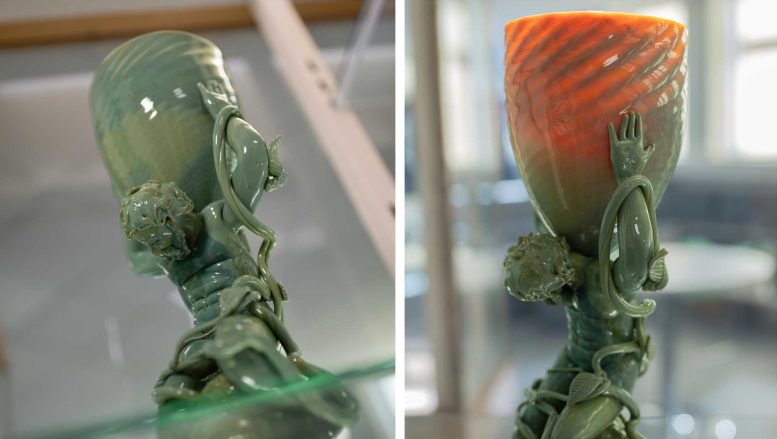
A University of Sheffield technician reproduced the Lycurgus Cup’s color-changing glass more than 1,600 years after it was made.
The fourth-century Roman cup is held at the British Museum and looks green when light reflects off it, but red when light passes through it.
It is a rare example of dichroic glass, whose appearance changes with the light.
Scientists think tiny gold and silver particles create the colors, but the Romans’ exact methods are unknown.
Earlier attempts to recreate the effect had mixed results, so the new recipe offers a more reliable way to make similar glass.
The project began when a Sheffield project manager asked technician Lisa Hollands to make the glass for the university’s 2025 LightFest.
Hollands worked with Roman glass expert Caroline Jackson, and the team’s work shows how modern methods can reproduce an ancient effect.

University of Sheffield researchers developed a recipe to reliably reproduce the Lycurgus Cup’s color-changing glass.
The fourth-century Roman cup appears green in reflected light and red when light passes through it.
The glass’s effect is linked to tiny amounts of gold and silver forming nanoparticles.
Technician Dr. Lisa Hollands worked with Roman glass expert Professor Caroline Jackson on the project.
The effort began after a request to recreate the glass for the university’s LightFest in 2025.
- Who
- University of Sheffield technician Dr. Lisa Hollands, working with Roman glass expert Professor Caroline Jackson.
- What
- The team developed a recipe to reproduce the Lycurgus Cup’s color-changing glass.
- When
- The work was prompted by a request for the university’s LightFest in 2025. The article was published on November 8, 2026.
- Where
- The University of Sheffield.
- Why
- To recreate the Lycurgus Cup’s unusual color-changing effect, which modern glassmakers had struggled to reproduce consistently.
This story does not have two clearly opposing sides.
Roman craftspeople created the Lycurgus Cup.
An international panel of artists and conservators named the cup one of the seven glass wonders of the world.
Hollands was asked to recreate the glass for the University of Sheffield’s LightFest.
SciTechDaily reported that Sheffield researchers had developed a recipe to reproduce the glass reliably.
- Cup date
- Fourth century AD
- Cup location
- British Museum
- Surviving Roman cage cups
- 40
- Project event
- University of Sheffield’s LightFest, 2025
- Glass expert
- Dr. Lisa Hollands
What people are saying
I knew that making a glass of this type was likely to be a complex task, as it is not just a case of adding nanoparticles to glass.
I’ve studied and worked with glass for over 25 years, so I used the knowledge and experience I’ve gained, coupled with a modern scientific understanding of what I was trying to achieve.
To start with, I worked with a leading Roman glass expert, Professor Caroline Jackson, to research what was already known about glass of the time and developed a base glass using modern materials to mimic what the Romans might have used.
Although if the Romans could have seen me experimenting, they’d probably laugh and ask: ‘Why does she not know how to make this?’