

Politics · Other · 4 hrs ago
South Africa’s municipal vote may deepen party fragmentation
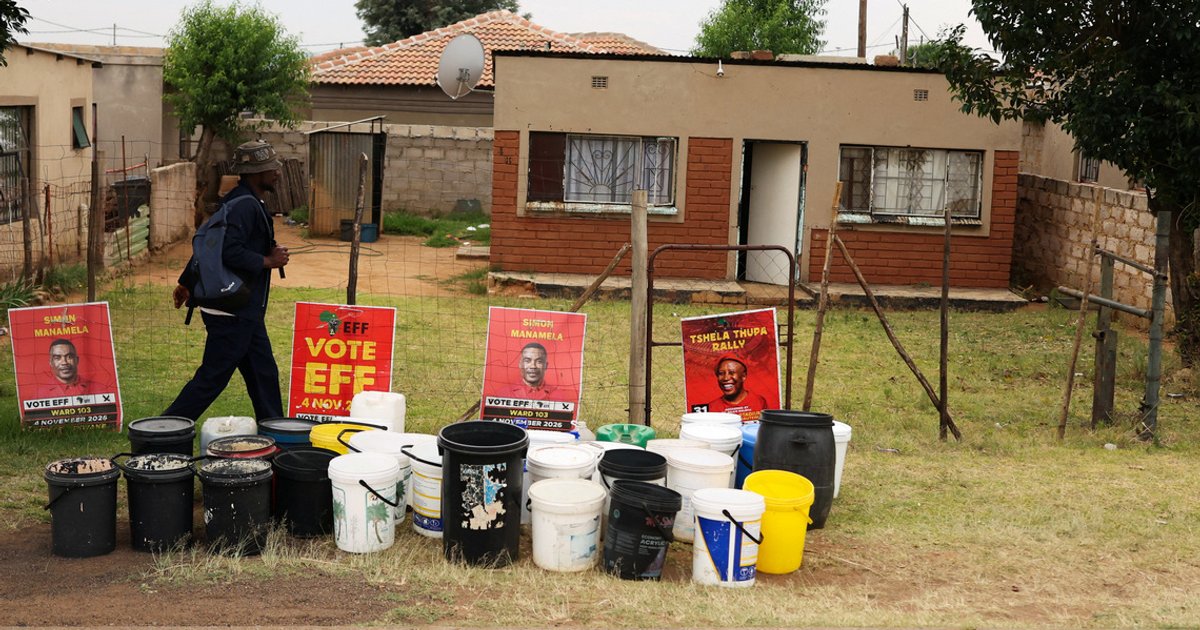
South Africans vote in municipal elections on November 4, choosing local governments across the country.
The ANC, which has long dominated national politics, is expected to remain the biggest party, but polls suggest it could lose substantial support.
Voters are also moving to the Democratic Alliance and other parties, leaving outright majorities harder to win.
That could mean rival parties must negotiate coalitions to run major cities, including Johannesburg, Tshwane and Ekurhuleni.
In Johannesburg, shifting alliances have contributed to service problems and financial decline; the city has had seven mayors since 2021.
Parties will have to decide whether to work together and form stable city governments, despite concerns that coalition deals can slow their plans.
The vote may also offer a signal about the national governing coalition and the future of its economic reforms, though market indicators suggest investors have few immediate concerns.

South Africa’s municipal elections on November 4 are expected to produce a more fragmented vote, making outright party majorities harder to secure.
Polls suggest the African National Congress will remain the largest party but could lose substantial support.
Voters are shifting toward several parties, including the Democratic Alliance, the Economic Freedom Fighters and uMkhonto weSizwe.
Without clear victories, parties may need to negotiate coalitions to govern major municipalities.
Analysts and community advocates say coalition stability will matter for services, infrastructure and investment.
- Who
- South African voters and political parties, including the ANC, the DA, the EFF and uMkhonto weSizwe.
- What
- Municipal elections are expected to deepen party fragmentation and could lead to coalition negotiations in major cities.
- When
- November 4; the articles were published on November 2, 2026.
- Where
- South Africa, including Johannesburg, Tshwane, Ekurhuleni and Cape Town.
- Why
- Voters are seeking change, jobs and improved services, while polls indicate declining support for the ANC and votes dispersing among multiple parties.
This story does not have two clearly opposing sides.
Mpho Moroka said she first voted for the ANC.
Johannesburg has had seven mayors since 2021, according to the article.
The Joburg Crisis Alliance was formed to address what its coordinator called coalition chaos.
The ANC and DA joined forces in the national government.
South Africa is due to hold municipal elections.
- Election date
- November 4
- Possible ANC support
- 31% to 34%, according to Oxford Economics Africa analyst Louw Nel
- ANC support in 2011 local elections
- More than 60%
- Johannesburg council seats
- 270
- Johannesburg mayors since 2021
- Seven
- Previous two Johannesburg mayors
- From a party with three of 270 council seats
3 sources
What people are saying
I'm from the township. I saw the poverty, I saw the struggles and I saw that there is no change,
It's created this huge instability. And when you confront political parties, they are able to divert the attack to the fact that it's a coalition,
Coalitions make it difficult for us to fully implement our programme,
By definition, coalitions hold you back,