

Science & Tech · Space · 6 hrs ago
Radiation caused heart scarring in rats in a simulated spaceflight study
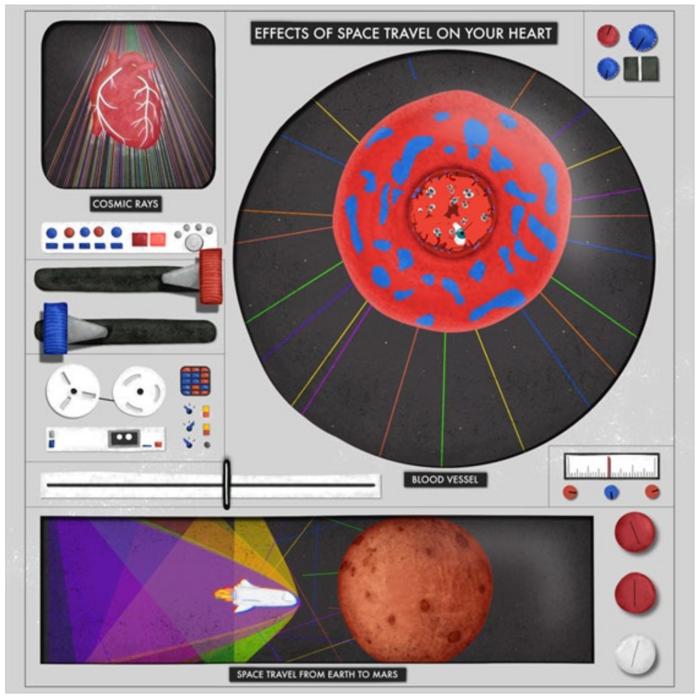
Researchers at the Medical College of Wisconsin studied spaceflight risks using rats because long-term tests on people would be impractical and unethical.
The middle-aged rats experienced simulated weightlessness and cosmic-ray radiation in a ground-based experiment.
At a radiation dose of 1.5 Gray, the rats developed scar tissue around the blood vessels that supply the heart.
The heart scarring doubled over 270 days, narrowing the vessels and making a heart attack more likely in the rats.
The simulated weightlessness did not appear to cause the heart damage; the researchers linked it to radiation.
The findings raise concerns about radiation risks on deep-space journeys, but the study tested rats, not astronauts.

A simulated spaceflight study found that radiation caused heart scarring in rats.
Researchers at the Medical College of Wisconsin used middle-aged rats to study the effects of simulated weightlessness and cosmic radiation.
At a radiation dose of 1.5 Gray, the rats developed scar tissue around coronary blood vessels.
The scarring had doubled in size 270 days after exposure, while simulated weightlessness had essentially no effect on this outcome.
- Who
- Researchers at the Medical College of Wisconsin conducted the study using middle-aged rats.
- What
- The study found that radiation caused scar tissue around the rats’ coronary blood vessels.
- When
- The article was published on October 14, 2026; the study’s exposure and monitoring periods are described, but its experiment date is not stated.
- Where
- Radiation exposure was simulated at the NASA Space Radiation Laboratory at Brookhaven National Laboratory.
- Why
- Researchers studied the possible long-term effects of deep-space radiation and weightlessness; human testing of this kind was described as impractical and unethical.
This story does not have two clearly opposing sides.
The rats were exposed to simulated cosmic radiation for a few minutes at high levels intended to mimic months of exposure.
The rats continued hindlimb unloading for another 25 days.
The rats’ heart scar tissue had doubled in size.
Researchers monitored the rats, a period the article equates to around 25 years of human life.
- Radiation dose
- 1.5 Gray
- Scar tissue
- Perivascular fibrosis around the coronary vessels
- Scarring increase
- Doubled in size 270 days after exposure
- Simulated weightlessness
- Hindlimb unloading at a 30-degree angle
- Radiation facility
- NASA Space Radiation Laboratory, Brookhaven National Laboratory