

Science & Tech · Space · 6 hrs ago
Rubin Observatory Finds Two Neptune Trojan Asteroids and a Candidate
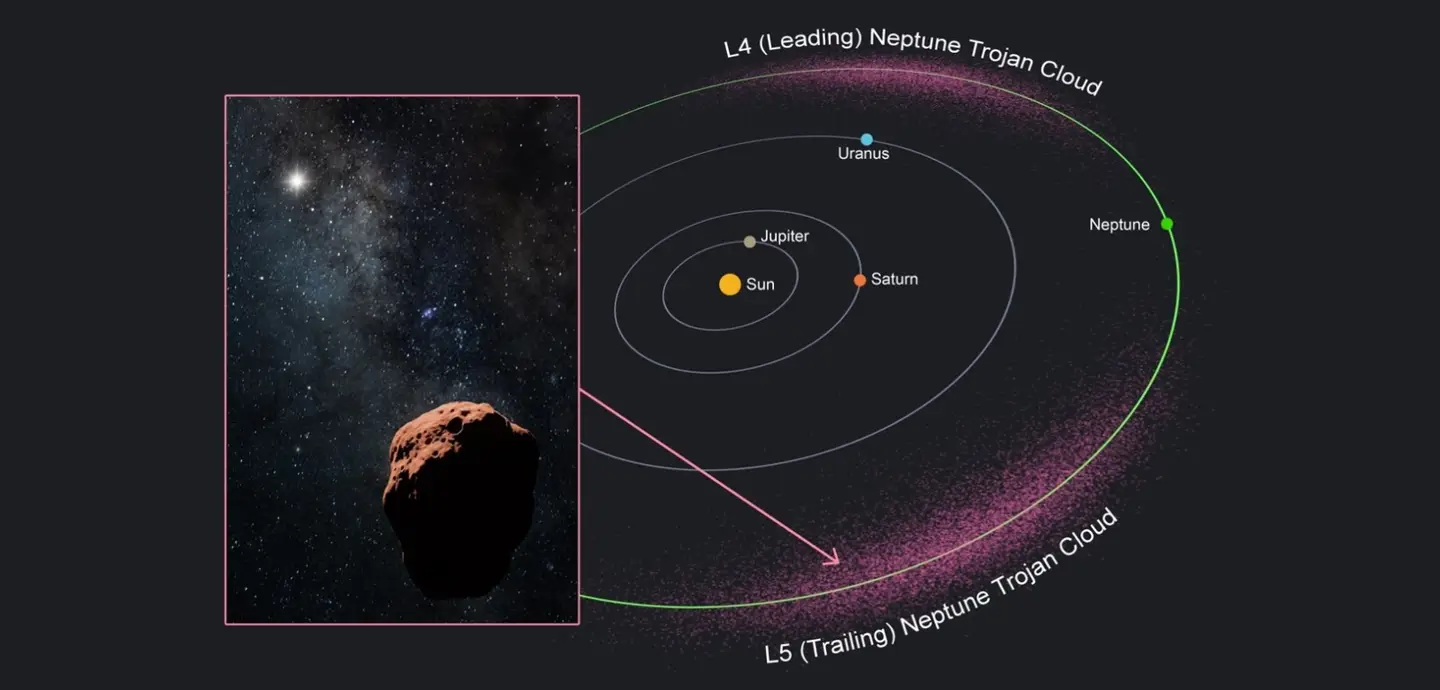
A Queen’s University Belfast-led team found two asteroids and a candidate in Neptune’s trailing Trojan population.
The objects were identified in early observations from the Vera C. Rubin Observatory in Chile.
Trojan asteroids share a planet’s orbit, leading or trailing it; similar groups are known around Jupiter, Saturn and Uranus.
Neptune’s Trojans had been hard to spot because they are distant and faint, and the region they occupied was obscured by the bright, crowded center of the Milky Way.
The findings double the number of known objects in Neptune’s trailing population on long-lived orbits.
The discovery offers a clearer view of these small Solar System bodies and shows how Rubin’s observations can help build an inventory of them.
Rubin’s ongoing sky survey is expected to bring more discoveries about objects in the Solar System.

A Queen’s University Belfast-led team identified two asteroids and a candidate as members of Neptune’s trailing Trojan population using data from the Vera C. Rubin Observatory.
The objects are described as primordial members on long-lived orbits.
The discovery provides a clearer view of Neptune’s trailing Trojan cloud, which has been difficult to observe because its objects are distant and faint.
For about ten years, the population was in front of the bright, crowded center of the Milky Way from Earth’s perspective.
The findings were detailed in a paper in The Astrophysical Journal Letters.
- Who
- An international team led by Dr. Meg Schwamb of Queen’s University Belfast.
- What
- The team identified two Neptune trailing Trojan asteroids and a candidate.
- When
- The article was published on October 30, 2026; the discovery used Rubin Observatory early test observations from the previous year.
- Where
- In data from the Vera C. Rubin Observatory, located in Chile.
- Why
- Rubin’s depth and sky coverage helped reveal distant, faint objects that had been difficult to spot.
This story does not have two clearly opposing sides.
Telescope observations revealed asteroid populations leading and trailing Jupiter.
Neptune’s Trojans were in a region of sky in front of the Milky Way’s center from Earth’s perspective.
The Vera C. Rubin Observatory began operations.
The team analyzed Rubin Observatory early test observations.
Universe Today published an article about the discovery.
- Objects identified
- Two asteroids and one candidate
- Population
- Neptune’s trailing Trojans
- Team lead
- Dr. Meg Schwamb, Queen’s University Belfast
- Observatory
- Vera C. Rubin Observatory, Chile
- Research paper
- The Astrophysical Journal Letters
What people are saying
Early data from Rubin Observatory is already expanding our knowledge of the solar system's 'small bodies,' including asteroids, comets, and other minor planets.
And these early observations have provided our clearest view yet of Neptune's trailing Trojan cloud.
The Trailing Cloud has now begun to move out of this region of sky and combined with the Rubin Observatory's unmatched depth and sky coverage, we've been able to double the number of known objects in this population on long-lived orbits.