

Science & Tech · Science & Environment · 4 hrs ago
Protein Crowding Increased Enzyme Activity in Laboratory Droplets
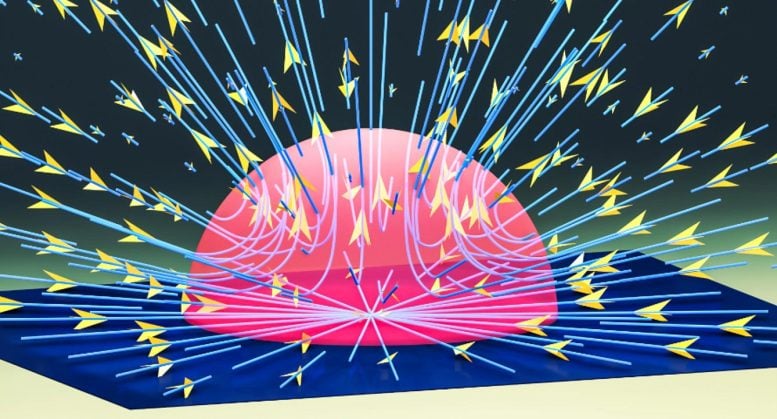
Researchers from OIST, the Max Planck Institute for Dynamics and Self-Organization and RIKEN studied enzymes in tiny droplets designed to mimic crowded conditions inside cells.
They added different amounts of a protein called BSA and tested two enzymes, LDH and ADH, with the molecules those enzymes act on.
Enzyme activity rose as protein crowding increased, but at very high concentrations, crowding began to hinder reactions.
Computer simulations suggested that nearby proteins helped LDH adopt a shape that made its reaction easier.
The team also found that active enzymes helped molecules move more freely through the droplets, unlike inactive enzymes.
Researchers proposed that chemical differences created by enzyme activity could generate tiny flows that help molecules mix.
The findings suggest the physical environment can influence cell chemistry, but the experiments were done in laboratory droplets and do not establish what happens in living cells.

Laboratory experiments found that enzyme activity increased as protein concentrations rose in droplets designed to mimic conditions inside cells, until crowding became very high.
The researchers tested lactate dehydrogenase and alcohol dehydrogenase in droplets containing different concentrations of bovine serum albumin.
Active enzymes also helped proteins and fluorescent nanoparticles move more freely through the droplets.
Simulations suggested that crowding favored a closed enzyme shape that made reactions easier.
The study involved researchers from OIST, MPI-DS and RIKEN.
- Who
- Researchers from OIST, MPI-DS and RIKEN.
- What
- They found that protein crowding increased enzyme activity in laboratory droplets up to a point, and that active enzymes increased molecular movement.
- When
- The article was published on 2026-11-27. The experiment date is not stated.
- Where
- In laboratory droplets designed to mimic conditions inside cells.
- Why
- To study how enzymes interact with crowded environments like those in cells.
This story does not have two clearly opposing sides.
Researchers prepared droplets with different concentrations of bovine serum albumin and tested enzyme activity.
RIKEN researchers modeled how protein crowding affected the shape of lactate dehydrogenase.
MPI-DS researchers proposed that enzyme activity creates concentration differences that generate tiny flows in the droplets.
- Protein used
- Bovine serum albumin (BSA)
- Enzymes tested
- Lactate dehydrogenase (LDH) and alcohol dehydrogenase (ADH)
- Research institutions
- OIST, MPI-DS and RIKEN
- Crowding effect
- Enzyme activity increased as BSA concentration rose, but very high concentrations began to interfere with reactions
- Publication date
- 2026-11-27
What people are saying
What’s fascinating is that we can connect interactions between individual atoms to the movement of molecules across an entire droplet. Events at the smallest scales can shape, and be shaped by, the physical behavior of a much larger system,
This initial increase in enzymatic activity seemed counter-intuitive, as you’d typically expect any level of crowding to impair movement of the enzymes and substrates and increase the liquid’s viscosity, therefore slowing down the reaction from the start.
When closed, the energy barrier required was much lower, allowing the reaction to happen more readily,
Similarly, we found that higher concentrations of the enzymes or their substrates in the droplets also increased mobility,