

Science & Tech · Space · 8 hrs ago
JWST observations point to early star clusters as possible black hole nurseries
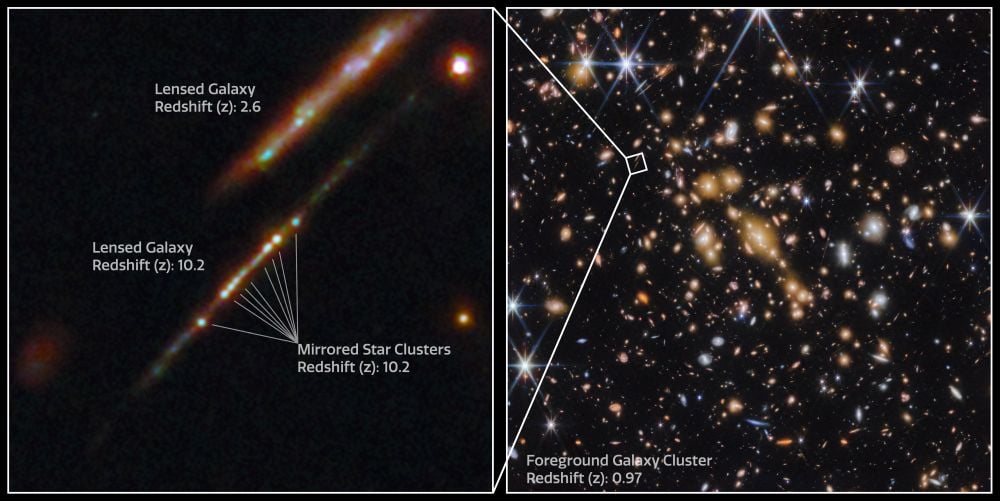
A study identifies dense star clusters as possible birthplaces of intermediate-mass black holes.
The clusters were found by the James Webb Space Telescope in two early galaxies, the Cosmic Gems arc and Firefly Sparkle.
The telescope saw these galaxies as they were hundreds of millions of years after the Big Bang.
Intermediate-mass black holes are heavier than black holes made from individual stars but lighter than supermassive black holes.
The researchers say collisions between stars in dense clusters could build these middle-sized black holes.
This matters because some intermediate-mass black holes may have acted as seeds for the supermassive black holes seen in the modern universe.
The study uses a model of runaway stellar collisions and mass loss from stellar winds; the available account does not say what happens next.

JWST observations of dense star clusters in two early galaxies suggest they may have been nurseries for intermediate-mass black holes.
The clusters are in the Cosmic Gems arc, seen as it was about 460 million years after the Big Bang, and Firefly Sparkle, seen about 600 million years after the Big Bang.
Researchers led by Viola Bocchi of Sapienza University of Rome say the clusters’ masses and compact sizes make them suitable for forming intermediate-mass black holes through collisions.
Such black holes could have acted as seeds for the supermassive black holes seen in the modern Universe.
- Who
- Researchers led by Viola Bocchi of Sapienza University of Rome.
- What
- They propose that dense star clusters observed by JWST may form intermediate-mass black holes.
- When
- The clusters are seen about 460 million and 600 million years after the Big Bang.
- Where
- The Cosmic Gems arc and Firefly Sparkle, two early galaxies.
- Why
- Dense clusters may enable collisions that form intermediate-mass black holes, which could serve as seeds for supermassive black holes.
This story does not have two clearly opposing sides.
JWST observed light from the Cosmic Gems arc, which contains five dense star clusters.
JWST imaged Firefly Sparkle and found 10 young massive clusters.
JWST observations of Cosmic Gems found five young massive clusters.
- Lead author
- Viola Bocchi
- Cosmic Gems age
- About 460 million years after the Big Bang
- Cosmic Gems clusters
- 5 young massive clusters
- Firefly Sparkle age
- About 600 million years after the Big Bang
- Firefly Sparkle clusters
- 10 young massive clusters
What people are saying
With masses in the range 105 M⊙–107 M⊙ and half-mass radii in the range ∼0.4–15 pc, these systems are ideally suited to form intermediate-mass black holes (IMBHs) via collision-based models