

Science & Tech · Space · 6 hrs ago
Study links disk changes to jets from a feeding black hole
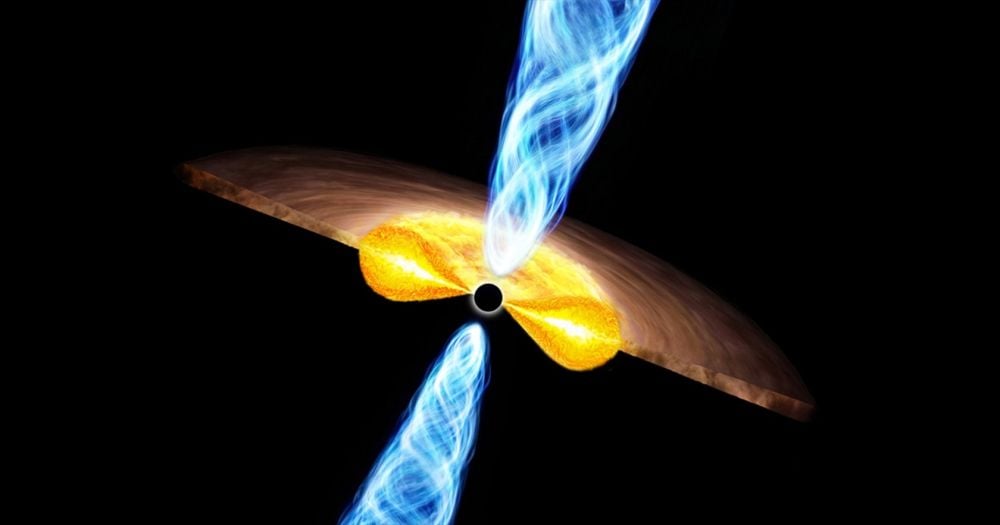
Researchers studied how a feeding black hole launches jets from the galaxy 3C 120, about 420 million light-years away.
The galaxy’s supermassive black hole is taking in material quickly while also sending out powerful jets of ionized gas.
The study used X-ray and radio observations to examine both the hot plasma near the black hole and the jets emerging from it.
A leading explanation for jet formation says magnetic fields in the disk of material around a black hole help launch the jets.
But rapidly feeding black holes are often thought to have thin, cold disks, which may not sustain the large-scale magnetic fields that explanation requires.
The researchers investigated this mismatch, and the study’s title links jet launching to a change in the disk’s extent.
The findings could help explain how powerful jets form and affect the gas and star formation in their host galaxies; the provided information does not say what comes next.

A study links changes in the accretion disk around a feeding supermassive black hole to the launch of relativistic jets.
The research examined 3C 120, an active galaxy that is rapidly accreting material and emitting jets.
Researchers used X-ray and radio observations to study the hot plasma near the black hole and the jet emerging from it.
X-ray observations detected an iron emission line that helped researchers estimate how close the disk reaches to the black hole.
The study was published in The Astrophysical Journal Letters.
- Who
- Researchers co-led by Hirofumi Noda and Kazuhiro Hada.
- What
- A study examined the link between accretion-disk changes and relativistic jet launching.
- When
- The article was published on 2026-10-22.
- Where
- The study focused on 3C 120, an active galaxy about 420 million light years away.
- Why
- To investigate the connection between accretion flows and jet launching.
This story does not have two clearly opposing sides.
This story does not have a timeline yet.
- Target galaxy
- 3C 120
- Distance
- About 420 million light years
- Black hole mass
- Approximately 6.3 × 10⁷ solar masses
- X-ray observatory
- X-ray Imaging and Spectroscopy Mission (XRISM)
- Publication
- The Astrophysical Journal Letters
What people are saying
By looking at the same black hole with state-of-the-art X-ray and radio telescopes, we were able to see both the hot plasma surrounding the black hole and the jet emerging from it,
Relativistic jets are among the most energetic phenomena in the Universe and influence galaxy evolution through energetic feedback, yet the physical connection between accretion flows and jet launching remains unresolved,