

Science & Tech · Science & Environment · 2 hrs ago
Healthy Coral Clones Help Bleached Corals Recover in Lab Tests
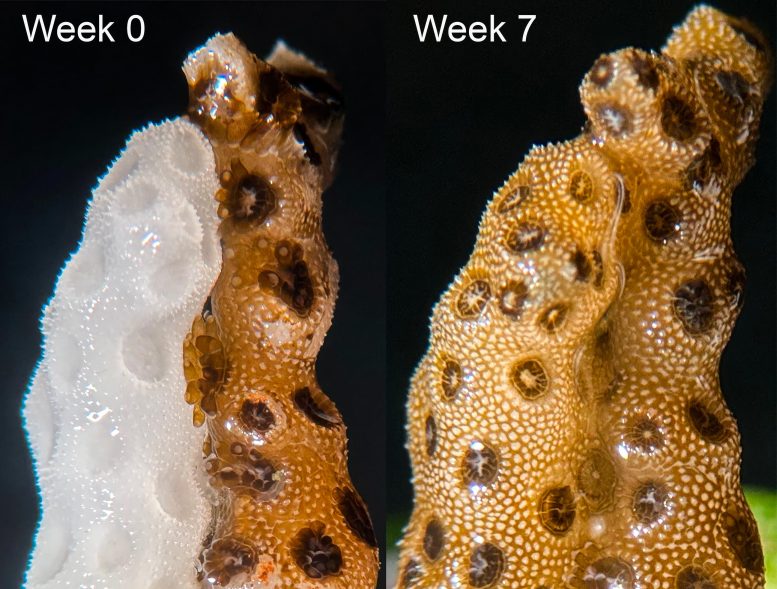
Stanford researchers restored bleached coral fragments in laboratory tests by briefly placing them against healthy fragments from the same coral clone.
Coral bleaching happens when warming water stresses corals, causing them to lose the algae that supply energy and give them color.
The team found that five days to a week of contact could kickstart recovery, with healthy coral tissue helping algae pass to the bleached coral.
After contact ended, the damaged fragments recovered in about seven weeks, while fragments kept apart from healthy partners died in the experiment.
The method required genetically identical corals; genetically different ones did not recover in the same way.
That requirement could make the approach difficult to use widely, even as bleaching threatens reefs around the world.
Researchers say the next step is to assess a broader algae-donation approach that might help more corals recover.

Researchers restored bleached corals in laboratory tests by briefly placing them in contact with healthy, genetically identical coral clones.
The bleached corals that touched healthy partners recovered within seven weeks, while fragments separated by small gaps died.
Contact allowed tissue fusion and the transfer of beneficial algae, which helped restart recovery.
The findings, published in Science Advances, suggest a possible way to support coral recovery but have not been tested in natural reefs.
The need for genetically identical coral partners may make the approach difficult to scale.
- Who
- Researchers led by Danny Collins and co-author Steve Palumbi at Stanford.
- What
- They found that brief contact with healthy, genetically identical coral clones helped bleached corals recover in laboratory tests.
- When
- The study was published October 14, 2026; the articles were published October 21, 2026.
- Where
- In laboratory tanks.
- Why
- The researchers tested whether contact with healthy coral could help bleached coral recover by transferring beneficial algae and nutrients.
This story does not have two clearly opposing sides.
Steve Palumbi noticed a healthy coral fragment touching a bleached fragment from the same colony, with color returning where they met.
The study was published in Science Advances.
Discover and SciTechDaily published articles about the findings.
- Study
- Published in Science Advances on October 14, 2026
- Experiment
- 10 pairs of coral fragments; five pairs touched and five were separated by gaps of a few millimeters
- Contact period
- One week, and in some cases as little as five days
- Recovery
- Bleached corals recovered within seven weeks after contact
- Required match
- Healthy and bleached corals had to be genetically identical clones
2 sources
What people are saying
While bleached corals may be dying, they are not dead yet
The question we wanted to answer is, once a coral has bleached, what can we do?
We see something similar in humans. Organ transplants are often successful if the donor is your identical twin.
Genetically identical corals recognize one another when they come into contact