

Science & Tech · Science & Environment · 4 hrs ago
Fiber-optic Cable Maps Hidden Cracks Inside a Swiss Glacier
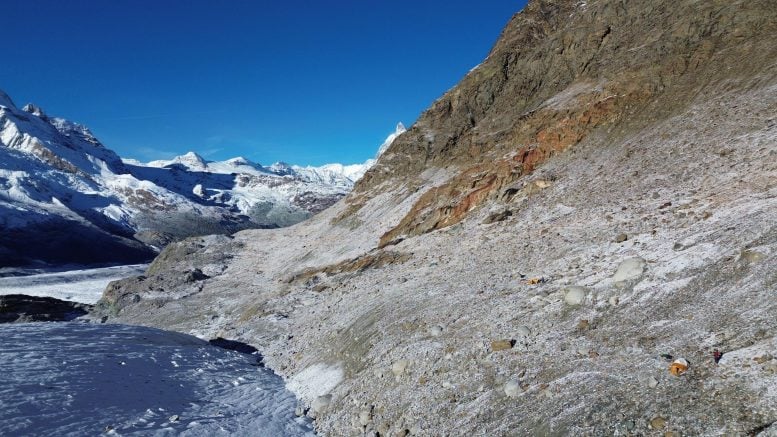
ETH Zurich researchers tested a fiber-optic cable on the Gorner Glacier in Switzerland’s Valais canton.
Opening cracks in ice create faint vibrations, which the cable detects by measuring changes in light passing through it.
The team used the method to examine the glacier down to 25 metres and build a picture of its hidden structure.
Crevasses occupied more than eight percent of the ice at the study site, while about 92 percent was intact.
The finding shows that a glacier’s visible surface may not reveal how damaged or stable it is inside.
Mapping internal cracks could help assess breakoff risks and support monitoring of unstable glaciers, with the aim of providing earlier warnings of large ice losses.

Researchers at ETH Zurich used a single fiber-optic cable to map hidden cracks inside Switzerland’s Gorner Glacier.
The survey found that water-filled or air-filled crevasses made up more than eight percent of the ice volume at the study site.
The method detected the glacier’s internal structure down to 25 meters.
Researchers say mapping internal damage could help assess the risk of ice breaking away from glaciers.
The technique may offer a simpler and less expensive alternative to installing many seismometers.
- Who
- Researchers at ETH Zurich, led by Assistant Professor Thomas Hudson.
- What
- They used a fiber-optic cable to map hidden cracks inside a glacier.
- When
- The study was published on November 18, 2026. The experiment date is not stated.
- Where
- Gorner Glacier, in Switzerland’s canton of Valais.
- Why
- To examine internal fractures that can weaken glaciers and help assess the risk of ice breaking away.
This story does not have two clearly opposing sides.
A collapse on Italy’s Marmolada Glacier killed 11 mountaineers.
Switzerland’s Birch Glacier collapsed above Blatten.
The ETH Zurich study on mapping cracks inside Gorner Glacier was published in Science Advances.
- Research team
- ETH Zurich, led by Thomas Hudson
- Study site
- Gorner Glacier, canton of Valais, Switzerland
- Survey depth
- 25 meters (82 feet)
- Crevasses at study site
- More than 8% of the ice volume
- Intact ice at study site
- Approximately 92%
What people are saying
A single fiber-optic cable replaces hundreds of seismometers
That’s far more than we expected.
Laypeople often assume that large, visible surface crevasses indicate whether a glacier is stable or not. However, scientists pay more attention to internal cracks and crevasses inside the ice
We are very pleased with the test runs on the Gorner Glacier. The method has proven its worth