

Science & Tech · Space · 2 hrs ago
Euclid space telescope accidentally discovers a new comet
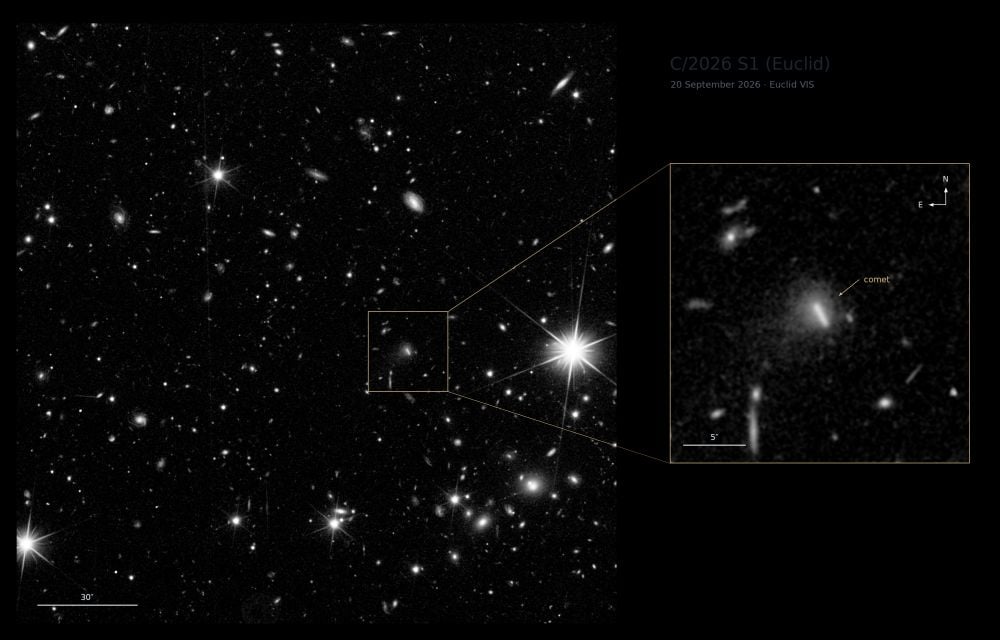
The Euclid space telescope has discovered a new comet while surveying the sky for distant galaxies.
Launched in 2023 by the European Space Agency, Euclid is on a six-year mission to study dark matter and dark energy.
Software designed by astronomer Mikko Pöntinen spotted the comet as a streak in images taken between September 16 and 24, 2026.
Its fuzzy cloud of dust and gas showed it was an active comet, and the Minor Planet Center confirmed it as C/2026 S1 (Euclid).
The comet is about 808 million miles from Earth and follows an unusual path above the plane where the planets orbit.
It takes thousands of years to complete an orbit, and Euclid was not expected to find it because the telescope avoids many areas crowded with comets and asteroids.
The discovery gives astronomers a chance to study an object left over from the early Solar System, and ground-based observations helped confirm it.

The European Space Agency’s Euclid telescope has discovered a comet, its first such discovery.
The comet, designated C/2026 S1 (Euclid), was identified in images taken in the Euclid Deep Field North.
Software developed by University of Helsinki astronomer Mikko Pöntinen flagged the object, and ground-based observations helped confirm it.
The comet follows a long-period orbit that takes thousands of years and arches above the plane followed by the planets.
- Who
- The European Space Agency’s Euclid space telescope, with the discovery identified by Mikko Pöntinen and the Euclid Consortium’s Solar System Objects Science Working Group.
- What
- The telescope discovered a comet designated C/2026 S1 (Euclid).
- When
- It appeared in images captured between September 16 and 24, 2026. The Minor Planet Center confirmed it on October 8.
- Where
- In the Euclid Deep Field North region, in the constellation Draco.
- Why
- Its unusual orbit brought it through one of Euclid’s fields of observation, although the telescope is not designed to search for comets.
This story does not have two clearly opposing sides.
Euclid was launched on a mission to study dark matter and dark energy.
The comet appeared in multiple images captured by Euclid.
The Minor Planet Center confirmed the comet and designated it C/2026 S1 (Euclid).
- Comet designation
- C/2026 S1 (Euclid)
- Discovery region
- Euclid Deep Field North, constellation Draco
- Image dates
- September 16–24, 2026
- Orbit
- Thousands of years to complete one orbit
- Distance from Earth
- Popular Science reports more than 807.7 million miles; Universe Today reports about 808 thousand miles.
3 sources
What people are saying
I was excited to see my software flag a ‘streak’ smeared across several images – the result of a fast-moving object
Very few comets are expected to be discovered by Euclid, so it was a happy coincidence