

Science & Tech · Space · 11 hrs ago
South Pole Telescope Searches the Cosmic Microwave Background for Primordial Signals
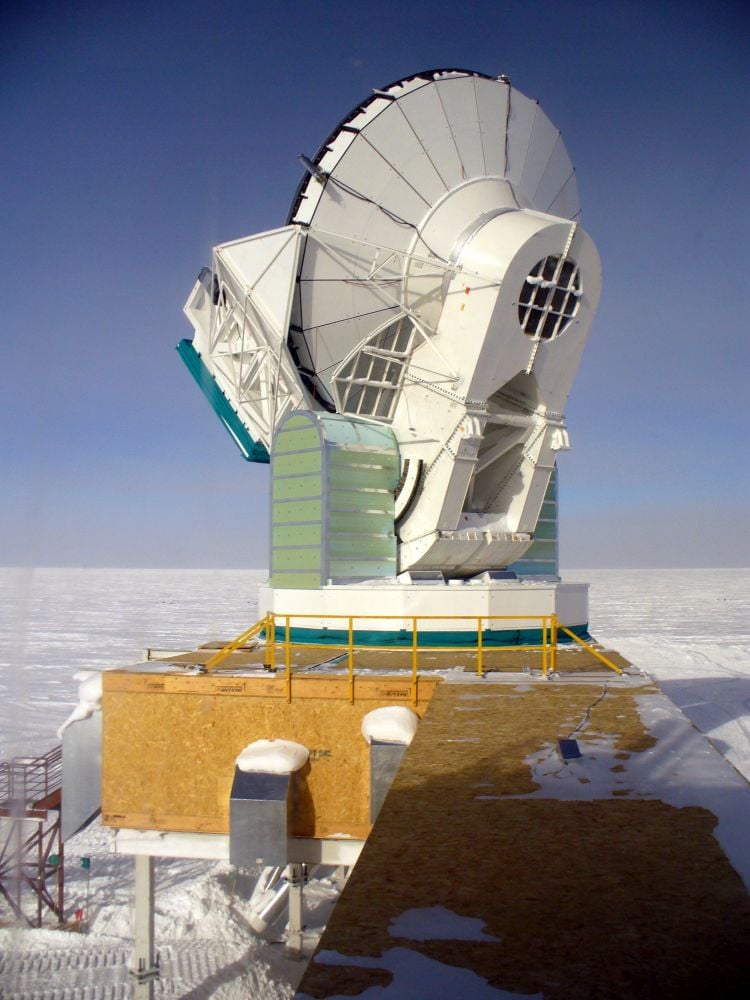
The cosmic microwave background is light from the early universe, released about 380,000 years after the Big Bang.
The South Pole Telescope in Antarctica studies tiny changes in this signal using a narrow window in Earth's atmosphere.
It has helped detect B-mode polarization, a pattern created when gravity from intervening matter bends the light.
Researchers are also searching for primordial gravitational waves from the universe's first moments.
Detecting them could offer a way to study quantum gravity, which current particle colliders cannot examine.
That could help connect Einstein's theory of gravity with quantum physics, and researchers are continuing to search the CMB for these signals.

The 10-meter South Pole Telescope in Antarctica observes part of the Cosmic Microwave Background through a small atmospheric window.
The telescope has been credited with discovering B-mode polarization in the CMB, produced by gravitational lensing from intervening matter.
Researchers are studying tiny variations in the CMB’s polarization for evidence of primordial gravitational waves.
Detecting such waves could offer insight into quantum gravity and help connect general relativity with quantum physics.
- Who
- Researchers working with the South Pole Telescope, including John Carlstrom and Kimmy Wu.
- What
- The telescope observes the Cosmic Microwave Background and searches for tiny polarization variations that could provide evidence of primordial gravitational waves.
- When
- The article does not state when the current search is taking place.
- Where
- At the South Pole in Antarctica.
- Why
- Primordial gravitational waves could provide evidence about quantum gravity and help bridge general relativity and quantum physics.
This story does not have two clearly opposing sides.
This story does not have a timeline yet.
- Telescope
- South Pole Telescope
- Mirror diameter
- 10 meters
- Location
- Antarctica
- CMB age
- About 380,000 years after the Big Bang
- First polarization detection
- 2002
What people are saying
It’s one of the ways that we can understand gravity at these very extreme scales
The fact that there could be primordial gravitational waves means that at the early fraction of a second when the universe was quantum fluctuations, gravity worked
We were sitting around with a small team, looking at our computer. There were peaks and wiggles, just as predicted
We were just staring at it and it was just phenomenal