

Science & Tech · Science & Environment · 4 hrs ago
X-rays can break water molecules apart before their electrons relax
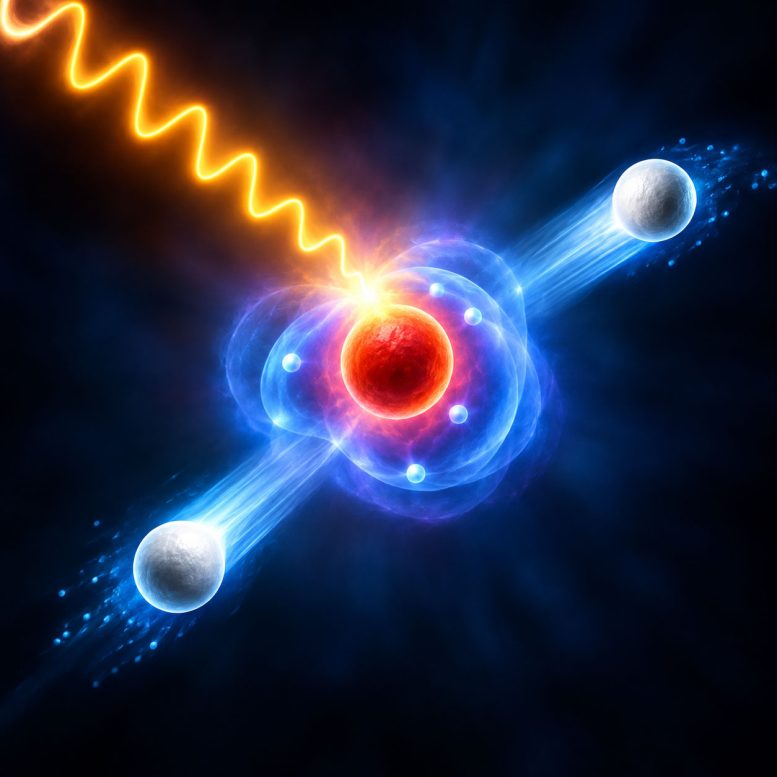
Researchers found that X-rays can make both bonds in a water molecule break before its electrons finish relaxing.
They studied isolated water molecules at two facilities, PETRA III in Hamburg, Germany, and MAX IV in Lund, Sweden.
When a water molecule absorbs an energetic X-ray, an electron can leave the oxygen atom, creating a vacancy that usually triggers a process called Auger decay.
The team’s measurements showed that the molecule can break apart before Auger decay is complete.
Calculations indicated that the resulting particles include an excited, neutral oxygen atom, rather than the hydroxyl fragments researchers had expected.
Because this oxygen atom is highly reactive, the finding could help explain earlier experimental signals and improve understanding of how water responds to radiation.

X-rays can break both bonds in a water molecule before its electrons complete a relaxation process, researchers report.
The breakup occurs within a few femtoseconds and leaves an excited, electrically neutral oxygen atom.
Experiments on isolated water molecules detected the signal at two synchrotron facilities.
Calculations linked the signal to excited neutral oxygen rather than hydroxyl fragments.
The finding suggests that some electron signals previously attributed to hydroxyl fragments may have a different source.
- Who
- Researchers, including Florian Trinter, Gunnar Öhrwall and Ludger Inhester.
- What
- They found that X-rays can cause both oxygen-hydrogen bonds in a water molecule to break before electronic relaxation is complete.
- When
- The breakup occurs within a few femtoseconds after X-ray excitation.
- Where
- Experiments were conducted at PETRA III at DESY in Hamburg, Germany, and the FlexPES beamline at MAX IV in Lund, Sweden.
- Why
- The X-ray-produced electronic state creates strong repulsive forces that allow the bonds to break before Auger decay.
This story does not have two clearly opposing sides.
An electron can be ejected from an inner shell of the oxygen atom, leaving a vacancy that normally triggers Auger decay.
Both oxygen-hydrogen bonds can break before Auger decay occurs.
Researchers detected unusually sharp electron-energy peaks in isolated water molecules.
Calculations matched the peaks to the decay of excited neutral oxygen atoms rather than hydroxyl fragments.
- Breakup timescale
- A few femtoseconds
- Bonds broken
- Both O–H bonds
- Product identified
- Excited, electrically neutral oxygen atom
- First facility
- PETRA III at DESY, Hamburg, Germany
- Second facility
- FlexPES beamline at MAX IV, Lund, Sweden
- Article publication
- 2026-11-22
What people are saying
What makes this result particularly exciting is that we see the molecule break apart before the electronic relaxation has even finished. Both O–H bonds rupture within the lifetime of the oxygen core hole, so the nuclear motion is essentially winning the race against the electrons
Seeing the characteristic signal also at MAX IV was an important part of establishing this as a genuine molecular fragmentation pathway. The measurements at the two facilities give us a very consistent picture of what happens to the water molecule after X-ray excitation
The energy of the emitted electrons provides a kind of fingerprint of the state that is formed. Our calculations show that the observed features are consistent with the decay of an excited neutral oxygen atom that has already separated from the water molecule