

Health · Medical Research · 2 hrs ago
Study identifies protein linked to age-related spinal disc damage
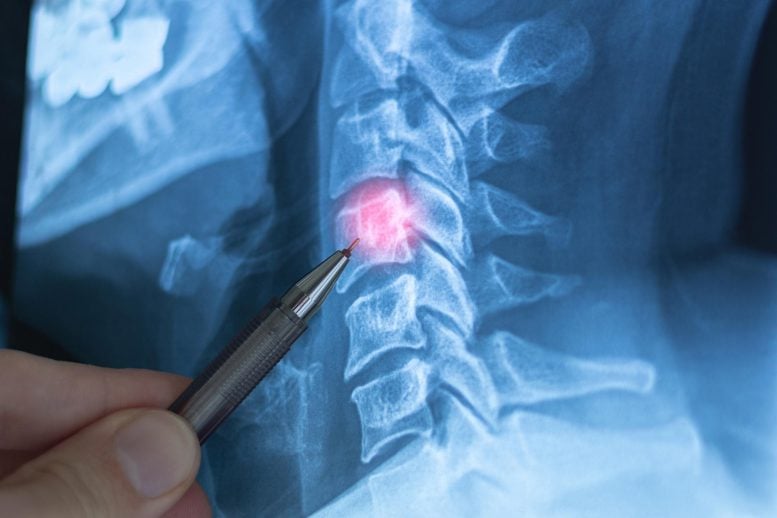
University of Utah researchers identified a protein called BLST that may help protect spinal discs as people age.
Spinal discs cushion the bones of the spine, and their deterioration can contribute to ongoing back pain.
In human disc cells tested in the lab, restoring BLST reduced signs of aging and DNA damage.
In mouse and rat models, reducing BLST activity led to disc degeneration and pain-related behaviors.
The findings suggest that BLST may help keep disc cells healthy, but they do not show that a treatment is ready for people.
Researchers say more preclinical work and clinical trials are needed to test whether increasing BLST is safe and effective.
The team also says the protein’s role in DNA damage could have relevance to cancer and neurodegeneration, but that possibility needs further study.

Researchers at the University of Utah found that older and damaged spinal discs had lower levels of the protein BLST.
Restoring BLST in human disc cells in the lab reduced signs of cellular aging and DNA damage.
Reducing BLST activity in mouse and rat models led to disc degeneration and pain-related behaviors.
The findings identify BLST as a possible target for future treatments for age-related back pain, but further studies are needed to assess safety and effectiveness in people.
- Who
- Researchers at the University of Utah, led by Robby D. Bowles.
- What
- The study linked low levels of the protein BLST to spinal disc damage and found that restoring it reduced cellular damage in human disc cells in the lab.
- When
- The study was published in Aging Cell. The article was published on November 25, 2026.
- Where
- The University of Utah; the research included human disc cells and mouse and rat models.
- Why
- Researchers investigated whether declining BLST levels contribute to age-related disc deterioration and back pain.
This story does not have two clearly opposing sides.
Researchers used CRISPR to restore BLST production in human disc cells and reduce its activity in mouse and rat models.
SciTechDaily reported on the research, which was published in Aging Cell.
- Protein
- BLST
- Gene
- ZNF865
- Human cells
- Restoring BLST reduced signs of cellular aging and DNA damage.
- Animal models
- Decreasing BLST activity led to disc degeneration and pain-related behaviors.
- Study journal
- Aging Cell
What people are saying
This paper directly shows a novel understanding that DNA damage is a driver of back pain, and that we can regulate BLST therapeutically with CRISPR
It has been the highlight of my career to work on a protein that was unknown and be the first to identify its function
The fact that a single gene can restore normal cell function and reverse aging-related effects is incredible