

Science & Tech · Space · 11 hrs ago
Webb data suggest a Little Red Dot could host a primordial black hole
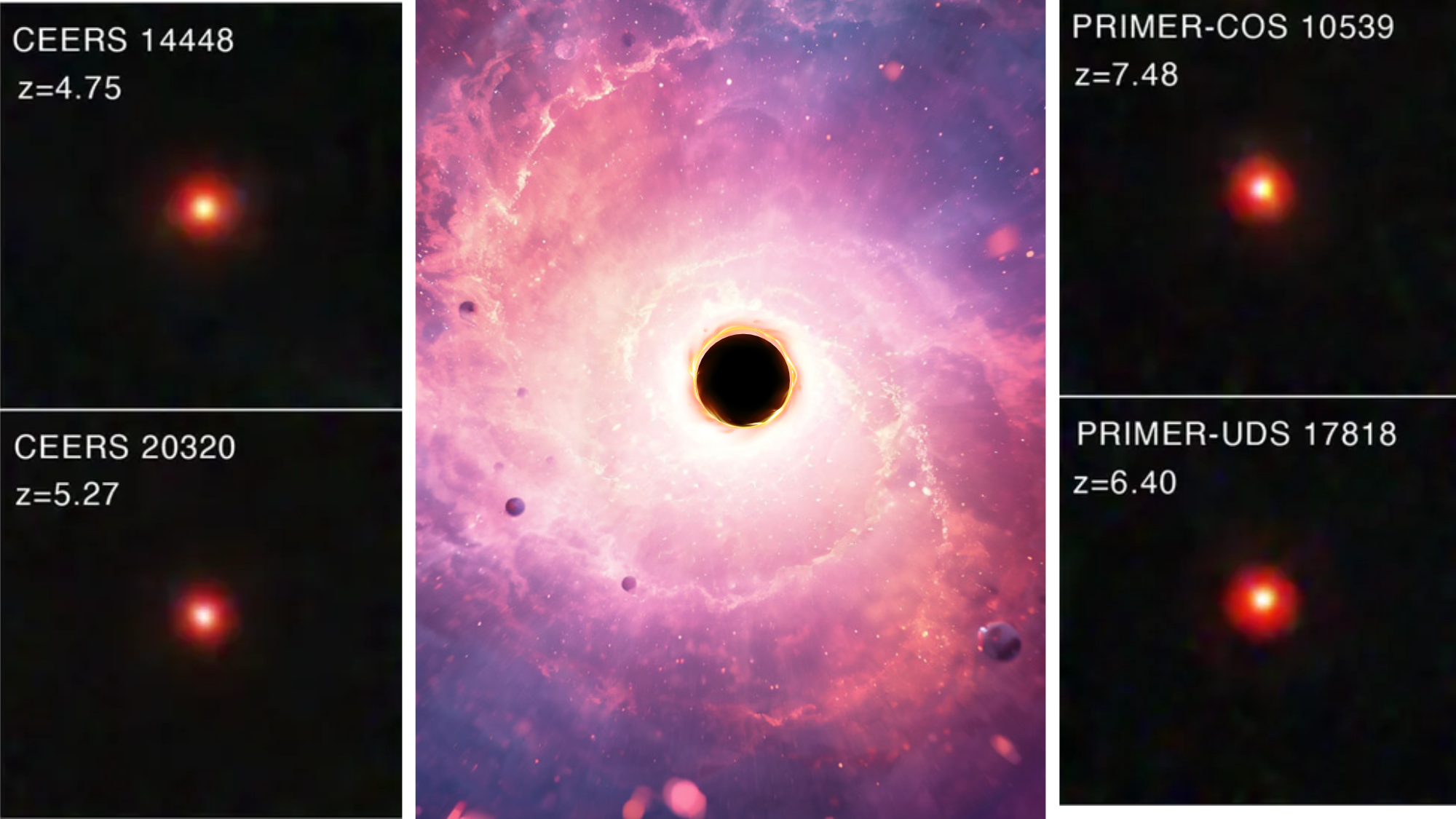
Researchers used Webb data to study a Little Red Dot called QSO1, about 13.1 billion light-years from Earth.
We see QSO1 as it was around 700 million years after the Big Bang, and it is made almost entirely of hydrogen and helium.
The team tested whether QSO1 could be linked to a primordial black hole, a type of black hole that may have formed from matter-density fluctuations in the early universe rather than from a dying star.
Scientists have proposed these black holes, but there is no hard evidence that they exist.
The team modeled three possible ways QSO1 might form and found the most likely involved a small primordial black hole growing by consuming nearby gas and energy.
This makes QSO1 a possible clue, not confirmation, and the study does not say what will happen next.

Researchers using James Webb Space Telescope data say the Little Red Dot blackAbell 2744-QSO1 could host a primordial black hole.
The object is seen as it was 700 million years after the Big Bang and is about 13.1 billion light-years from Earth.
The team modeled how a Little Red Dot like QSO1 could form from a primordial black hole.
The researchers found that the most likely scenario they considered involved a smaller primordial black hole consuming gas and energy until it grew to QSO1's size.
Primordial black holes have not been confirmed, and the researchers say their existence remains uncertain.
- Who
- Researchers including Valerio De Luca and Loris Del Grosso of Johns Hopkins University.
- What
- The team used Webb data and modeling to assess whether QSO1 could host a primordial black hole.
- When
- QSO1 is seen as it was 700 million years after the Big Bang. The study date is not stated.
- Where
- The object is blackAbell 2744-QSO1, about 13.1 billion light-years from Earth.
- Why
- The team tested whether Little Red Dots could be primordial black holes and how such an object might form.
This story does not have two clearly opposing sides.
The telescope revealed Little Red Dots, which appear to disappear before the universe is two billion years old.
The team modeled how a Little Red Dot like QSO1 could form from a primordial black hole.
- Object
- blackAbell 2744-QSO1 (QSO1)
- Distance
- Around 13.1 billion light-years from Earth
- Cosmic age observed
- About 700 million years after the Big Bang
- Telescope
- James Webb Space Telescope
- Likely modeled scenario
- A smaller primordial black hole consumes surrounding gas and energy and grows to QSO1's size
- Composition
- Almost entirely hydrogen and helium
What people are saying
A black hole is an object born from the gravitational death of a star. Primordial black holes are a very different story
Little Red Dots could surround astrophysical black holes, and most probably many of them do, but they could also be primordial black holes, if primordial black holes exist
So the question becomes, Which ones are primordial and how can we tell?
There are constraints on primordial black holes from cosmological observations