

Science & Tech · Science & Environment · 1 hr ago
A cell-signaling model may explain different mammalian hair patterns
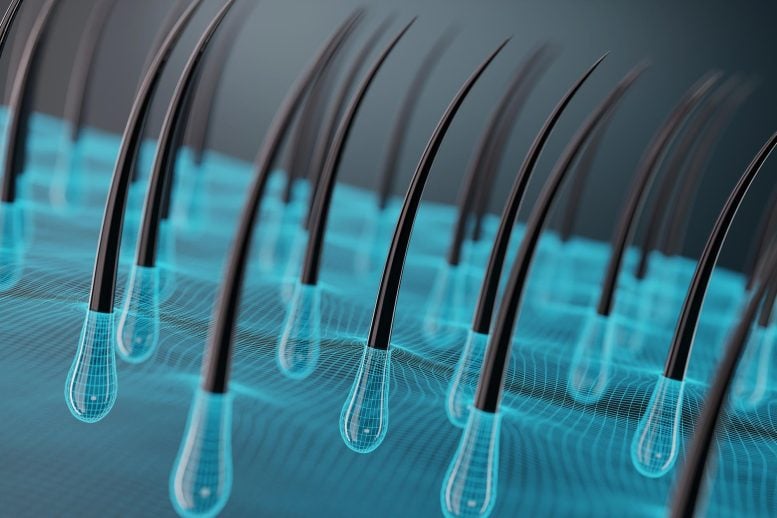
University of Geneva researchers modeled how hair follicles form patterns in the skin of two mammal species.
Hair follicles start developing before birth in structures called placodes, but scientists have debated how these structures become organized.
A traditional model says each placode releases a signal that prevents nearby placodes from forming for a time.
The new model uses cells moving toward chemical signals from the skin’s outer layer.
It reproduced patterns seen in laboratory mice and spiny mice, whose follicles form a distinctive directional arrangement.
The results suggest one process could help explain different patterns, with variations in cell interactions and skin growth between species.
The model does not prove this process operates in living skin, so further evidence would be needed to establish how follicles form.

Researchers at the University of Geneva developed a mathematical model that may explain how hair follicles form different patterns in mammals.
The model proposes that cells moving in response to chemical signals can produce follicle arrangements without instructions specifying each follicle’s position.
It reproduced patterns described in laboratory mice and spiny mice, which have different follicle arrangements.
The findings challenge the expansion-induction model as a general explanation for hair follicle organization across mammals.
The researchers said the model’s agreement with observed patterns does not prove that chemotaxis operates in living skin.
- Who
- Researchers at the University of Geneva, co-led by Athanasia Tzika and Michel Milinkovitch.
- What
- They developed a mathematical model in which cells responding to chemical signals generate mammalian hair follicle patterns.
- When
- The study was published in PNAS; the publication date is not stated.
- Where
- The research was conducted at the University of Geneva and modeled patterns in laboratory mice and spiny mice.
- Why
- To investigate how developing tissues establish organized hair follicle patterns across mammalian species.
This story does not have two clearly opposing sides.
The researchers modeled how chemical signals and cell movement could produce the developmental pattern observed in laboratory mice.
The team adapted the model using experimental data from three-dimensional imaging of spiny mouse embryonic skin.
- Institution
- University of Geneva
- Publication
- PNAS
- First species modeled
- Laboratory mouse (Mus musculus)
- Second species modeled
- Spiny mouse (Acomys dimidiatus)
- Proposed process
- Chemotaxis: cells moving in response to chemical gradients
What people are saying
Our findings show that the observed patterns do not require a complex system telling each placode where to form
Our work suggests that simple cellular interactions can generate the remarkable diversity of tissue architectures observed throughout evolution