Science & Tech · Space · 2 hrs ago
Juno Data Shows Jupiter’s Magnetodisk Ripples During Active Periods
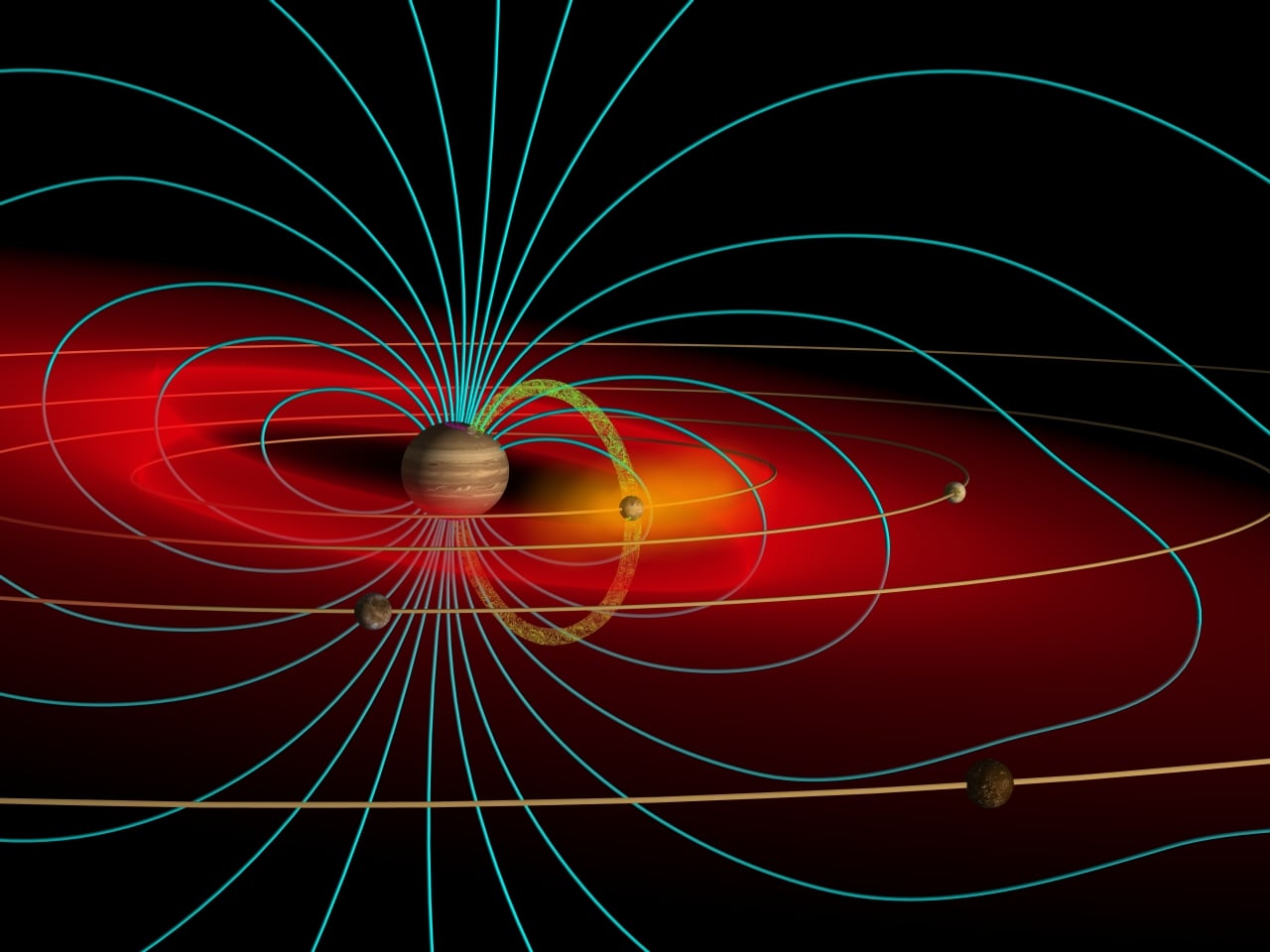
Juno data show Jupiter’s magnetodisk ripples during active periods, rather than behaving like a smooth sheet.
The magnetodisk is a ring-shaped region of magnetic activity, driven by Jupiter’s fast rotation and material from its volcanic moon Io.
An international team analyzed magnetic-field and particle readings from Juno during several events in the disk.
They found that the spacecraft crossed the disk’s current sheet repeatedly, detecting magnetic changes and bursts of energized particles.
Small reconnection sites push the sheet into waves that can last from a few minutes to more than an hour, and Jupiter’s rotation carries those ripples around the planet.
The changing sheet could affect how Io’s particles move and accelerate, and may complicate the connection between Jupiter’s upper atmosphere and its magnetodisk.
Juno is scheduled to continue its extended mission until September 2028, allowing it to gather more data about Jupiter.

Juno data show that Jupiter’s magnetodisk forms a rippling, wave-like structure during active periods.
The international research team analyzed magnetic-field and energetic-particle activity during multiple magnetodisk events.
Juno crossed the magnetodisk’s current sheet repeatedly during reconnection events, detecting magnetic signatures and bursts of energized particles.
The team found that small-scale reconnection sites push the current sheet away from its equilibrium position as the disk rotates with Jupiter.
The findings may help explain how Io’s volcanic particles are accelerated and transported.
- Who
- An international research team led by researchers from Shandong University analyzed the data.
- What
- Juno data show that Jupiter’s magnetodisk ripples during active periods.
- When
- The article was published on October 13, 2026. The data covered multiple magnetodisk events; their dates are not stated.
- Where
- Jupiter’s magnetodisk.
- Why
- The team found that small-scale magnetic reconnection sites break magnetic field lines and push the current sheet away from equilibrium.
This story does not have two clearly opposing sides.
NASA’s Juno probe began studying Jupiter and its magnetosphere.
Universe Today published an article on Juno data showing a rippling magnetodisk.
Juno’s extended mission is scheduled to end.
- Spacecraft
- NASA’s Juno probe
- Research lead
- Shandong University researchers
- Normal current-sheet crossings
- Twice per 9.9-hour rotation
- Reconnection sites
- About 100 degrees of longitude
- Mission end
- Scheduled for September 2028
Related
Perseverance rover sets record for driving distance on another world
1 hr ago · 14 sources

Canadian astronaut Joshua Kutryk shares first impressions from space
1 hr ago · 3 sources
SpaceX launch creates glowing ‘jellyfish’ over Alabama and East Coast
5 hrs ago · 8 sources

SpaceX brings Starship stage back to Texas for inspection
1 hr ago