

Science & Tech · Science & Environment · 10 hrs ago
Himalayan marmot droppings may help track climate change
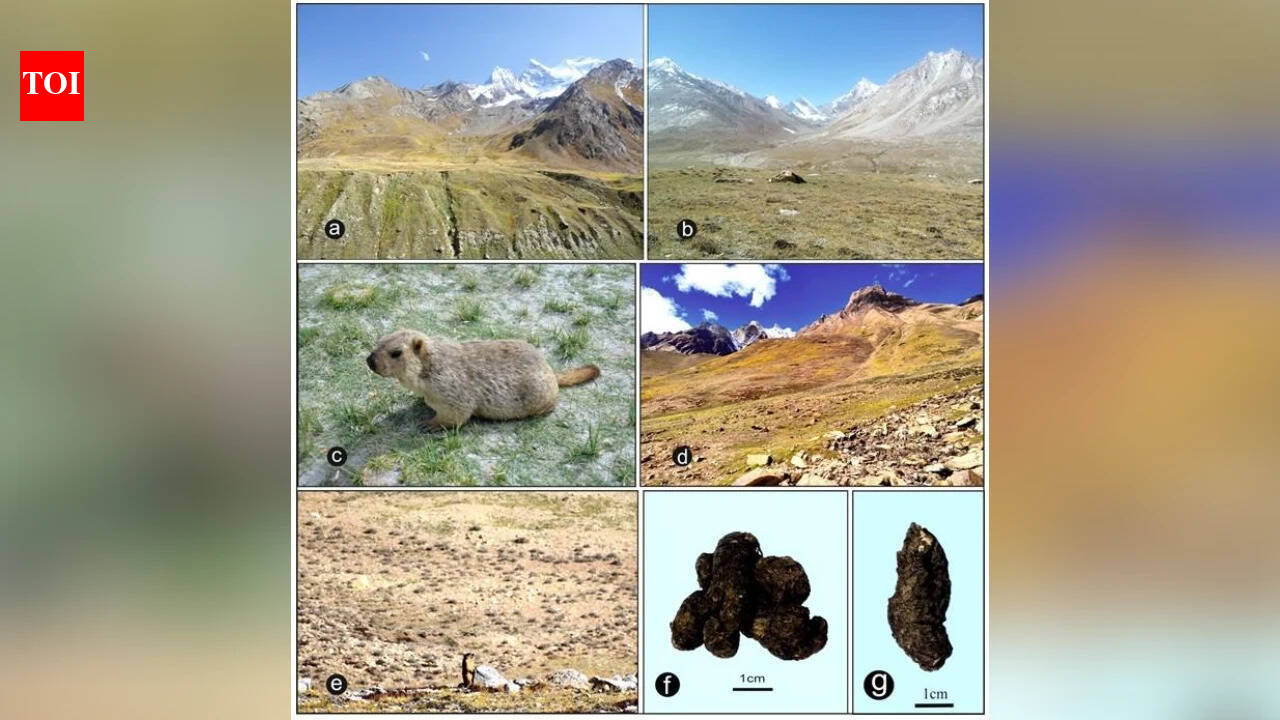
Scientists at the Birbal Sahni Institute of Palaeosciences studied Himalayan marmot droppings collected from two regions.
The marmot lives in cold, dry high-altitude areas and eats local plants, so its droppings can preserve clues about the vegetation around it.
Researchers identified pollen, fungal spores and elemental signatures in the samples using laboratory methods.
They found plant groups that reflect alpine vegetation and used pollen ratios to interpret vegetation patterns and related climate conditions.
The findings suggest marmots could help track environmental change in parts of the Himalaya where lake sediments, peat and soil evidence can be scarce.
Changes in marmot habitat may also point to shifts in altitude, and the animals are important prey for snow leopards.
The findings could support future ecological studies and wildlife conservation, though the study presents the droppings as an additional tool for research.

A study found that pollen, fungal spores and elemental signatures in Himalayan marmot faeces may help track vegetation and environmental change in the higher Himalaya.
Researchers from the Birbal Sahni Institute of Palaeosciences analysed faecal samples collected from two Himalayan regions.
The study’s findings were published in PLOS One.
The researchers say the marmot could serve as an indicator species for understanding vegetation and climate changes.
The approach could help study remote mountain environments where conventional evidence, such as lake sediments and peat, is scarce.
- Who
- Scientists from the Birbal Sahni Institute of Palaeosciences.
- What
- They studied whether Himalayan marmot faeces could help reconstruct environmental changes.
- When
- The findings were published on November 21, 2026.
- Where
- Two Himalayan regions; the article does not name the sample-collection locations.
- Why
- To explore an alternative biological archive for studying vegetation and environmental conditions in the higher Himalaya.
This story does not have two clearly opposing sides.
Researchers collected faecal samples from two Himalayan regions.
The team examined pollen, fungal spores and elemental composition in the samples.
The study’s findings were reported as published in PLOS One.
- Researchers
- Birbal Sahni Institute of Palaeosciences
- Sample regions
- Two Himalayan regions
- Journal
- PLOS One
- Pollen groups identified
- Artemisia, Asteroideae, Caryophyllaceae, Poaceae, Cyperaceae and Chenopodiaceae
- Species
- Himalayan marmot (Marmota himalayana)