

Science & Tech · Space · 6 hrs ago
Simulations suggest Little Red Dots are remnants of collapsed primordial stars
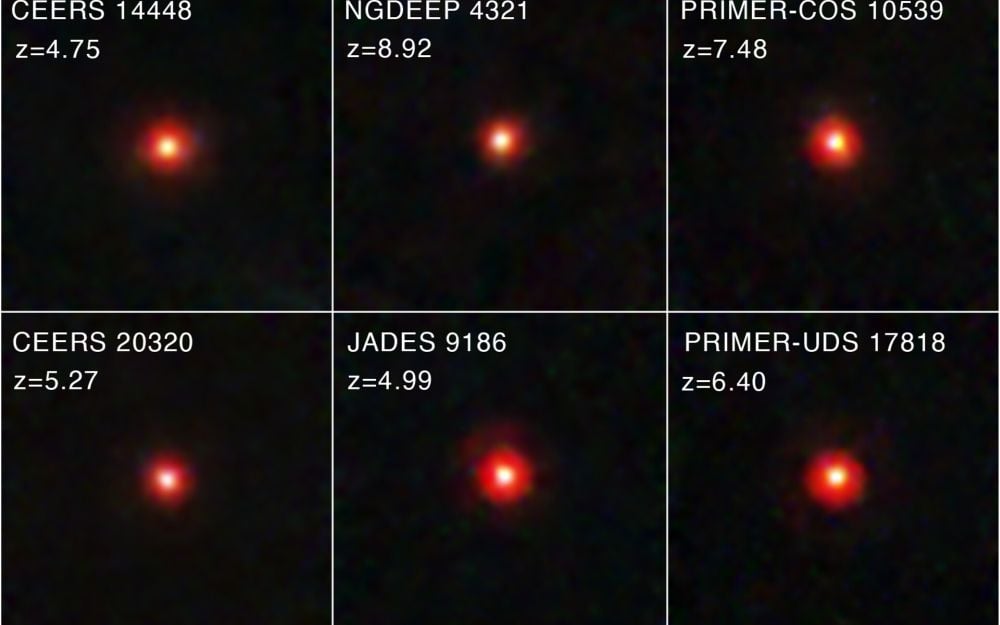
JWST found many bright, compact galaxies nicknamed Little Red Dots in deep views of the cosmos.
They are unusually abundant and their properties have been difficult to explain with existing ideas about how galaxies formed.
Some researchers proposed they were powered by young supermassive black holes, but forming so many black holes so soon after the Big Bang poses challenges.
New cosmological simulations suggest the dots may be remnants of collapsed supermassive primordial stars instead.
The simulations offer a possible way to explain the dots’ brightness, compact size and unusual spectra, though other explanations have also been considered.
Understanding the dots could help explain how early galaxies and black holes formed in the young universe.

Simulations by an international team suggest Little Red Dots may be remnants of collapsed supermassive primordial stars.
The objects were identified in James Webb Space Telescope deep-field observations and are bright, red and more numerous than cosmological models predicted.
The team’s study was led by Daniel Whalen of the University of Portsmouth’s Institute of Cosmology and Gravitation.
The findings were published in The Astrophysical Journal Letters.
- Who
- An international team of astronomers led by Daniel Whalen.
- What
- Simulations suggest Little Red Dots may be remnants of collapsed supermassive primordial stars.
- When
- The study was published on 2026-11-17.
- Where
- The objects were seen in James Webb Space Telescope deep-field observations. The researchers’ institutions include the University of Portsmouth.
- Why
- The simulations offer an explanation for the objects’ observed properties, which previous theories have struggled to explain.
Direct Collapse Black Hole theory
Collapsed supermassive primordial star remnants
Explanation
Direct Collapse Black Hole theory
It proposes that supermassive black hole seeds formed directly from massive clouds of cold gas.
Collapsed supermassive primordial star remnants
The simulations suggest Little Red Dots may be remnants of collapsed supermassive primordial stars.
Challenges
Direct Collapse Black Hole theory
Gas fragmentation, the need for specific radiation conditions and feedback that could slow growth pose challenges.
Collapsed supermassive primordial star remnants
The source presents this as an explanation supported by simulations, but gives no specific challenges to it.
Astronomers found numerous bright, red objects later nicknamed Little Red Dots.
Universe Today reported that simulations suggest Little Red Dots may be remnants of collapsed supermassive primordial stars.
- Nickname
- Little Red Dots (LRDs)
- Size
- A few hundred light-years across
- Study lead
- Daniel Whalen, University of Portsmouth
- Publication
- The Astrophysical Journal Letters
- Publication date
- 2026-11-17
What people are saying
LRDs have been one of the most surprising discoveries made by the James Webb Space Telescope. They are compact, only a few hundred light-years across, but are as bright as much larger galaxies, and their unusual V-shaped spectra have defied the usual astrophysical explanations. Their lack of detectable X-ray and radio emissions has left astronomers struggling to explain what they are.