

Science & Tech · Cybersecurity · 1 hr ago
Fake Italian Government App Used Spyware to Target Asylum Seekers
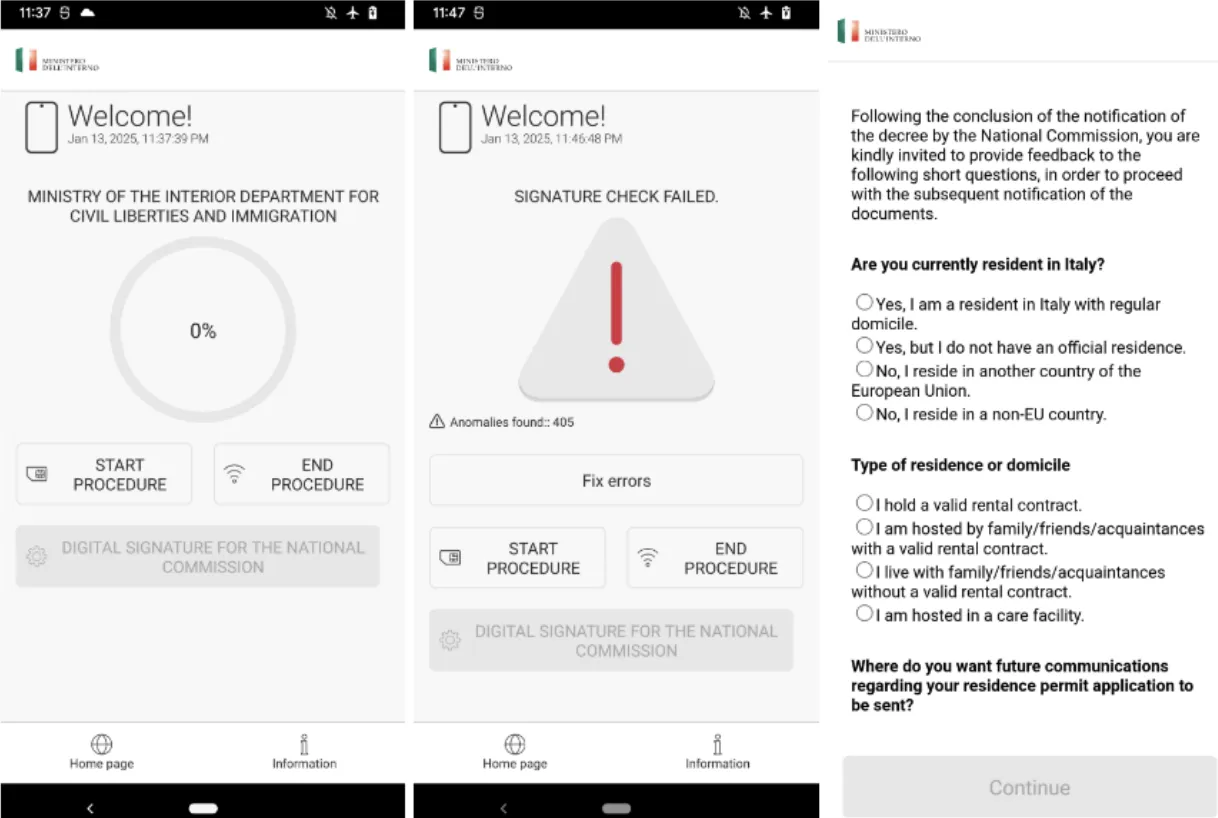
A fake app promising asylum seekers updates on their status installed spyware on Android phones in Italy.
The app used the Interior Ministry logo and a protection decree, but police deny any link to the operation.
An investigation attributed the spyware, called Morpheus, to IPS, a company that supplies law enforcement and intelligence agencies; who ordered the operation and who was targeted remain unknown.
The spyware could access private data and use a phone’s microphone, record its screen or track its location.
The case comes amid wider concerns about Italy’s surveillance industry, where spyware use has grown and oversight remains limited.
A civil liberties coalition wants to know who authorized the operation and what it achieved, while the app’s original download site has been unreachable since 2025.

A fake Android app posing as an Italian Interior Ministry service used Morpheus spyware to target asylum seekers.
The app, called FirmaDigitale, claimed to provide updates on protection status but instead delivered spyware.
An investigation attributed the malware to IPS, a Latina company that supplies prosecutors, police and intelligence agencies.
It is not known who ordered the operation or whom it affected.
The case has renewed concerns about spyware oversight and the targeting of vulnerable people.
- Who
- Asylum seekers in Italy were targeted. The malware was attributed to IPS.
- What
- A fake government app delivered Morpheus spyware capable of accessing phone data and functions.
- When
- The app’s website has been unreachable since 2025. The investigation was reported on November 28, 2026.
- Where
- Italy.
- Why
- Not stated. The identity of whoever ordered the operation is unknown.
Privacy advocates and civil liberties groups
Magistrates’ association
Authorization and oversight
Privacy advocates and civil liberties groups
Osservatorio Nessuno criticized weak rules, opacity and a lack of ethical limits on spyware operations. Cild called for answers about who authorized the targeting of asylum seekers.
Magistrates’ association
Magistrates’ association vice president Marcello De Chiara described spyware as essential and current safeguards for its use as adequate.
Private vendors
Privacy advocates and civil liberties groups
Osservatorio Nessuno raised concerns about the proliferation of spyware companies and the absence of constraints.
Magistrates’ association
De Chiara called for tighter rules for private vendors, including a national register and clearer ownership.
Lookout discovered the malware, according to the investigation.
The website used to distribute the app became unreachable.
Osservatorio Nessuno named the spyware Morpheus after finding it in a fake Fastweb app.
Security Affairs reported on the fake app and the investigation attributing the malware to IPS.
- App
- FirmaDigitale, an Android app posing as an Interior Ministry service
- Spyware
- Morpheus
- Malware attribution
- IPS, a Latina supplier to prosecutors, police and intelligence agencies
- Distribution website
- firmadigitale.assistenza-mobile[.]it
- Known operator
- Unknown; the article says nobody knows who ordered the operation or whom it hit.
What people are saying
We are faced with yet another example of low-cost spyware that exploits vulnerability and suffering to strike at one of every individual’s most intimate rights: the privacy of the devices we use daily for all our activities and communications.
This case is particularly cruel because it leverages—from a position of supreme power—systems that are already discriminatory and hostile, specifically targeting migrants.
Why burn a rare exploit when a convincing form will do?