

Business · Companies · 13 hrs ago
Spanish rail safety debate turns to maintenance and railway management
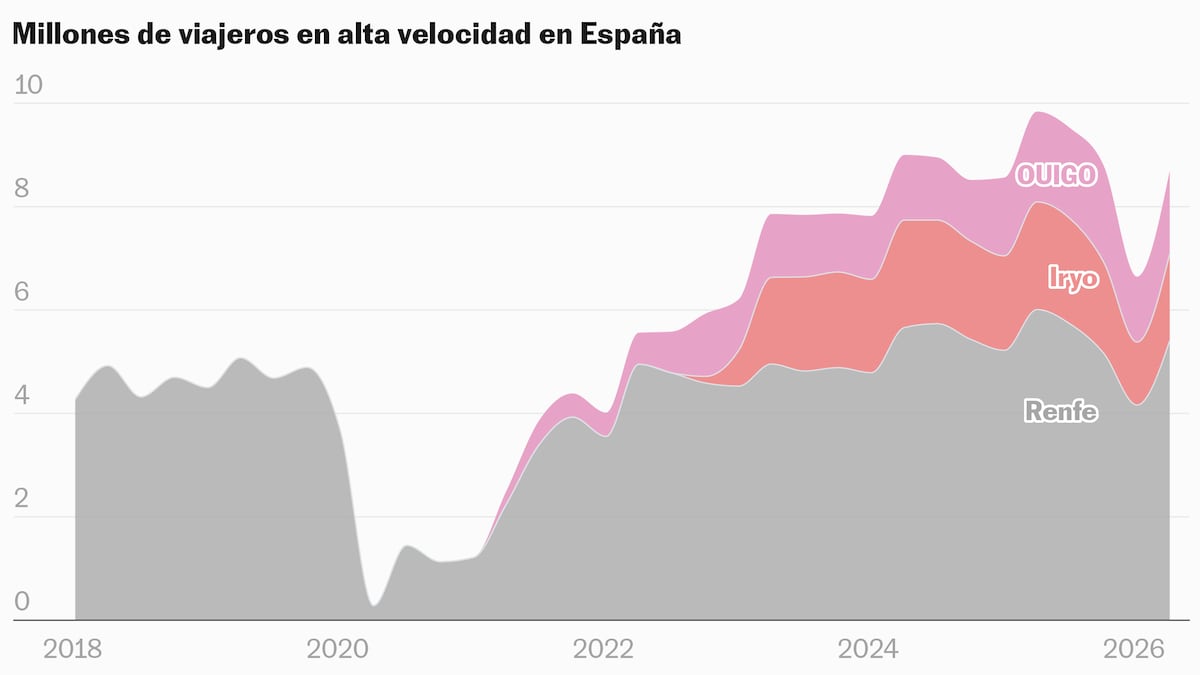
After two accidents that killed 115 people on Spain’s Madrid-Seville high-speed line, calls have grown to renationalise rail services.
Spain opened passenger rail to competition, while Adif remains the public manager of tracks, stations and train traffic.
The change was intended to attract more passengers by offering cheaper and faster journeys, and to make better use of the network.
Experts cited in the coverage say there is no clear link between who owns train operators and safety, and argue the network can handle more trains than it currently runs.
Engineer Iñaki de Barrón estimates high-speed rail needs €10 billion for maintenance over ten years, and says conventional rail needs attention too.
He recommends urgent independent and Adif audits of the network, staffing and safety, followed by a review of operating rules.

The Urda rail accident in Toledo has renewed scrutiny of Spain’s rail liberalisation and the safety of its high-speed network.
Former prime ministerial chief of staff Iván Redondo proposed renationalising the railways after the accident, drawing support from parties to the left of the Socialist Party.
Experts cited by Cinco Días dispute that rail ownership is linked to safety and say the available data do not show that Spain’s network is overloaded.
Rail infrastructure, maintenance and traffic management remain public responsibilities, with Adif managing the network.
Rail engineer Iñaki de Barrón has called for an extensive safety audit and estimated that high-speed rail maintenance needs €10 billion over the next decade.
- Who
- Iván Redondo proposed renationalising Spain’s railways. Rail engineer Iñaki de Barrón and other experts discussed safety and network management.
- What
- The Urda accident has prompted debate over rail liberalisation and safety. Experts disagree with claims that private operators or increased traffic explain the accidents.
- When
- The reporting was published on 8 November 2026. Redondo made his proposal on the first Monday after the Urda accident.
- Where
- Urda, Toledo, and Spain’s rail network, including the Madrid-Seville high-speed line.
- Why
- The accident and reports of 115 deaths in two high-speed rail accidents in 2026 have prompted questions about safety, ownership and maintenance.
Supporters of renationalisation
Experts who dispute a link between ownership and safety
Cause of safety problems
Supporters of renationalisation
Redondo proposed renationalising the railways; parties to the left of the Socialist Party backed the proposal.
Experts who dispute a link between ownership and safety
Experts cited by Cinco Días said there is no established link between safety and train ownership.
Traffic and capacity
Supporters of renationalisation
The proposal followed claims that liberalisation was responsible for deaths in high-speed rail accidents.
Experts who dispute a link between ownership and safety
The available data do not show that the network is saturated or that it carries more trains than it can support.
Renfe was separated from Adif and became solely responsible for passenger transport.
Italy opened its passenger rail market to a private company.
Iván Redondo proposed renationalising Spain’s railways.
El País interviewed Iñaki de Barrón at the College of Civil Engineers in Madrid.
Cinco Días and El País published reports on the accident, rail safety and liberalisation.
- Deaths reported
- 115 in two high-speed rail accidents in 2026
- Maintenance estimate
- €10 billion for high-speed rail over the next 10 years, according to Iñaki de Barrón
- Adif leadership
- Adif manages train traffic and is responsible for maintaining existing infrastructure
- Renfe separation
- Renfe was separated from Adif in 2005
- Italy’s open market
- Italo began operating in 2012 and reached 40% of high-speed services on the Rome-Milan corridor
2 sources
What people are saying
What is more efficient is a much less politicised management model, in which the presidents of public companies and their boards of directors are not subject to the swings of political change.
An urgent audit, one independent and another by Adif, to compare them and see what could most affect the functionality and safety of the railway system.
The high-speed network should be safe, and it is.
Posts on X
He estado estos días en silencio en las redes, como tantos otros paisanos, por lealtad a mis compatriotas, que se merecen guardarles silencio. Las víctimas y los trabajadores son las entrañas de nuestro país. Por respeto a todos ellos explico sin complejos lo que haría: aprobaría