

Health · Medical Research · 4 hrs ago
Study links industrialized lifestyles to changes in gut bacteria
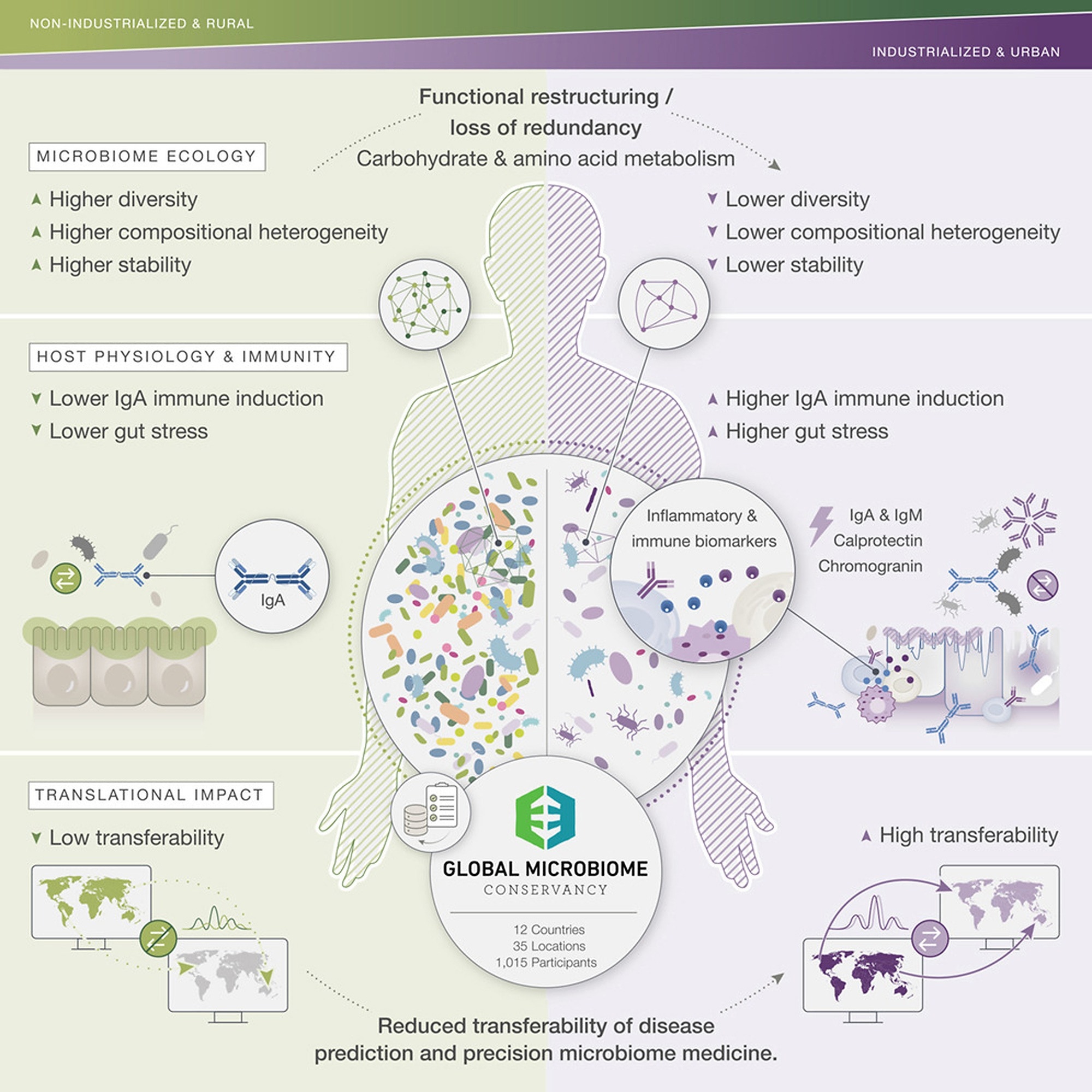
Researchers compared gut bacteria and intestinal health in 1,015 adults across 12 countries with different levels of industrialization.
They found that more-industrialized lifestyles were linked to lower bacterial diversity, with similar patterns across countries.
People in more-industrialized populations also had more similar gut microbial communities, which appeared less stable in computer analyses.
Their stool samples showed higher markers of intestinal stress and more immune activity, but there was no consistent increase in intestinal inflammation across the study group.
A health index based on microbiome data from industrialized populations worked poorly for people in non-industrialized populations.
The study compared people at one point in time, so it cannot show that industrialization caused these changes or how individuals’ gut bacteria shift over time.

A study of 1,015 adults across 12 countries linked more-industrialized lifestyles with lower gut bacterial diversity.
The researchers also found that more-industrialized populations had more similar microbial communities and lower stability in computational network analyses.
These microbial changes were accompanied by higher intestinal stress markers and greater secretion of mucosal immunoglobulin A, without a consistent increase in intestinal inflammation.
A microbiome-based health index developed with data from industrialized populations performed poorly when applied to non-industrialized populations.
The study compared participants at a single time point and examined associations among lifestyle, diet, genetics and gut-related measures.
- Who
- Researchers studied 1,015 adults across 12 countries.
- What
- The study examined associations between industrialized lifestyles, gut microbial communities and intestinal immune and stress measures.
- When
- Published on November 4, 2026.
- Where
- Participants came from 35 localities in 12 countries.
- Why
- The researchers sought to examine how lifestyle, diet and genetics relate to gut microbes and intestinal responses.
This story does not have two clearly opposing sides.
This story does not have a timeline yet.
- Participants
- 1,015 adults
- Geographic scope
- 12 countries and 35 localities
- Host genotyping
- 913 participants
- Study design
- Cross-sectional, measuring participants at a single time point
- Publication
- Cell