

Science & Tech · Science & Environment · 3 hrs ago
Bacteria Detect Viral Attacks by Sensing a Phage Enzyme
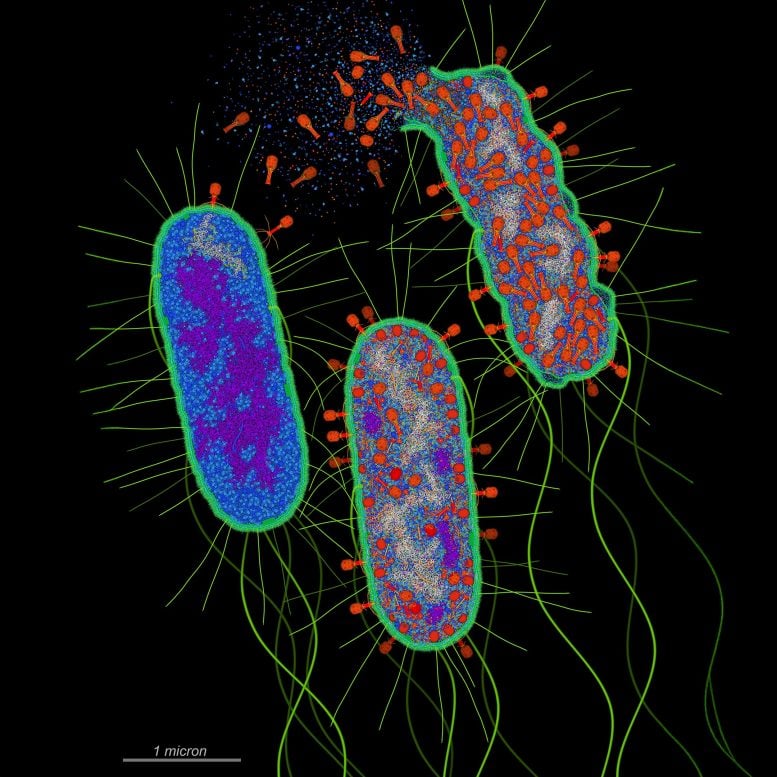
Researchers at the University of Utah found how bacteria detect some viral attacks: a defense system called CBASS senses the activity of an enzyme used by the invading virus.
The work, published in Science, studied bacteriophages, viruses that infect and kill bacteria.
When a phage enzyme cuts a bacterial sensor protein, it activates CBASS, which can make the infected bacterium kill itself before the virus multiplies and spreads.
This differs from defenses that detect viral genetic material, such as DNA or RNA.
The discovery may help scientists develop phage treatments that can better evade bacterial defenses, which could matter as antibiotic resistance makes some infections harder to treat.
CBASS is related to an immune pathway in humans, pointing to an ancient connection in the evolution of immunity.
Researchers may use this new understanding to improve phage therapy, though the findings do not say when or how such treatments might change.

Researchers found that some bacteria detect invading phages by sensing the activity of a viral enzyme.
The phage enzyme cuts a bacterial sensor protein, triggering the CBASS immune system.
CBASS can cause an infected bacterium to kill itself before the virus multiplies and spreads.
The findings could help scientists develop phage therapies that better overcome bacterial defenses.
The research was published in Science.
- Who
- Researchers led by Sam Hobbs, an assistant professor of biochemistry at University of Utah Health.
- What
- They found that a phage enzyme can cut a bacterial sensor protein and activate CBASS immunity.
- When
- The research was published on October 17, 2026.
- Where
- University of Utah Health is identified as Hobbs’s institution. The research location is not stated.
- Why
- Understanding how bacteria recognize phages could help scientists develop more effective phage therapies.
This story does not have two clearly opposing sides.
This story does not have a timeline yet.
- Immune system
- CBASS
- Viral enzyme
- Protease
- Bacterial response
- The infected bacterium can kill itself before the virus multiplies and spreads
- Research publication
- Science
- Lead author
- Sam Hobbs, University of Utah Health
What people are saying
This is one of the most common forms of bacterial immunity, so when we finally figured it out, it was a total eureka moment
We found that the protease from the phage actually acts directly on the host protein, and that is the signal that turns on the whole signaling pathway.
This is a totally new mechanism for how these host proteins are activated