

Science & Tech · Space · 1 hr ago
Australian father and son win NASA lunar-wheel competition
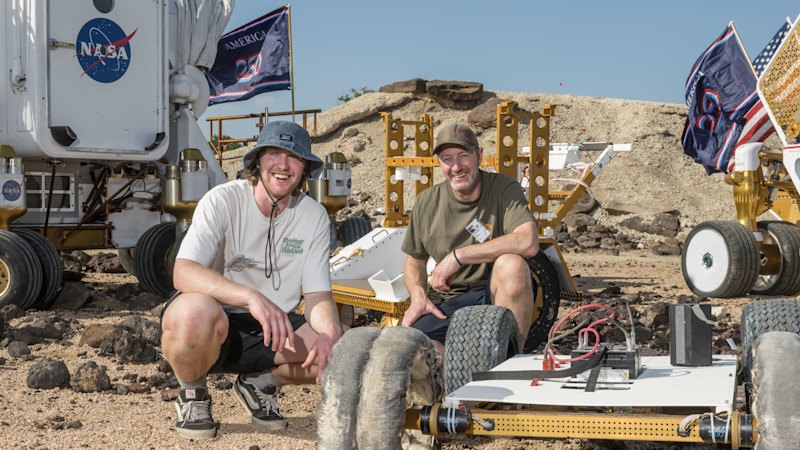
Australian father and son Daniel and Isaac Bloomfield won a NASA competition in Houston, Texas, in July.
Their backyard-built lunar-wheel design beat entries from international aerospace teams in a challenge worth $220,000.
The competition tested designs for wheels intended for use on the Moon.
Daniel is a former engineer who became a full-time carer for his older sons, who had a degenerative disorder.
He developed and tested prototypes at home, and his son Isaac joined him for the competition.
NASA engineers tested the design, including on simulated lunar gravel, where it performed best; no further steps are stated.

Australian father and son Daniel and Isaac Bloomfield won a NASA lunar-wheel competition in Houston in July.
Daniel Bloomfield’s backyard-designed invention outperformed designs from international aerospace teams.
The competition was worth $220,000.
The pair were among five finalists selected from 96 entries.
Isaac said the sand test was their main concern, but their prototype performed best in that test.
- Who
- Former engineer Daniel Bloomfield, 47, and his son Isaac, 20, an electrician.
- What
- They won a NASA lunar-wheel competition with Daniel’s backyard invention.
- When
- July; the article was published on November 26, 2026.
- Where
- NASA’s research centre in Houston, Texas.
- Why
- The competition tested lunar-wheel designs. The source does not state why Daniel entered.
This story does not have two clearly opposing sides.
Daniel entered the NASA competition.
His design was shortlisted as one of five from 96 entries.
Daniel and Isaac travelled to Houston and won the competition.
- Prize value
- $220,000
- Finalists
- Five selected from a longlist of 96
- Daniel Bloomfield
- 47-year-old former engineer
- Isaac Bloomfield
- 20-year-old electrician
- Competition location
- Houston, Texas
- Prototype test
- It performed best in the sand test
What people are saying
It felt surreal to win.
I’m proud to be his son.
During testing, the only thing that worried us was the sand test [driving the prototype over low-traction simulated lunar gravel], which we ended up being best at.