

Science & Tech · AI · 36 mins ago
Facial Rover uses close-up scans to create digital replicas of visitors
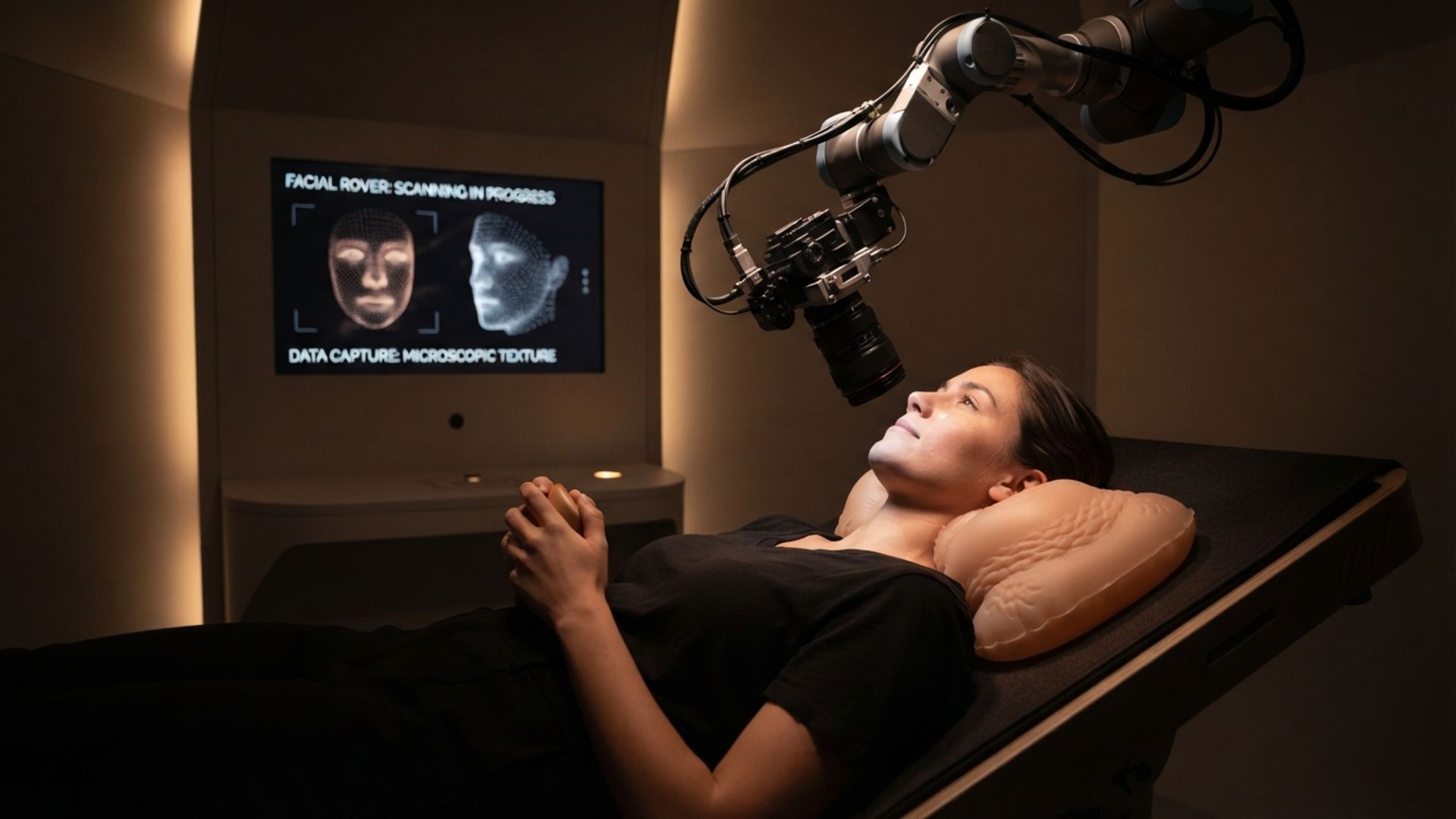
Researchers and artists tested a robot that scans faces at an exhibition in Dubai.
Called Facial Rover, it was developed by researchers from the University of Nottingham with artists at Blast Theory.
Visitors reclined inside a booth while a camera moved close to their faces and sensors captured fine skin details.
A conversational system spoke with them, while a robotic neck moved in a breathing rhythm beside them.
The system uses those scans to make a digital replica of each participant.
The team is studying how people respond to a robot entering their personal space and how they divide attention among its voice, movement and touch.
The trials also raise questions about privacy and trust in AI and robots.
The public trials ran from November 18 to 21, 2026, at Emirates Towers during Dubai’s STARS exhibition; the sources do not say what happens next.

Researchers from the University of Nottingham and artists at Blast Theory created Facial Rover, a robotic installation that scans visitors’ faces to build digital replicas.
The reclining booth uses a motorized macro camera, conversational software and a tactile controller.
An inflatable robotic neck moves with a breathing rhythm beside participants during the sessions.
Public trials took place at Emirates Towers in Dubai during the STARS exhibition from November 18 to November 21, 2026.
Researchers are studying how people respond to close-range robotic scanning and how attention, privacy and trust shape the experience.
- Who
- Researchers from the University of Nottingham and artists at Blast Theory developed Facial Rover. Visitors took part in its trials.
- What
- The installation scans facial features to construct a digital replica.
- When
- Public trials ran from November 18 through November 21, 2026. The prototype was completed in October 2026.
- Where
- Emirates Towers in Dubai, during the STARS exhibition.
- Why
- Researchers are studying how people respond to close-range AI and how attention, privacy and trust affect interactions with robots.
This story does not have two clearly opposing sides.
The Facial Rover prototype was completed.
Public trials took place at Emirates Towers during Dubai's STARS exhibition.
- Developers
- University of Nottingham and Blast Theory
- Installation
- Facial Rover
- Trial venue
- Emirates Towers, Dubai
- Trial dates
- November 18–21, 2026
- Session length
- 12 to 15 minutes
What people are saying
I was surprised at how intimate it feels to have AI looking at you and speaking softly to you from such close proximity.
It could also help us to learn more about ethical issues of privacy and trust in robots and AI.