

Science & Tech · Science & Environment · 1 hr ago
Researchers Create Diamondiyne, a New Porous Form of Carbon
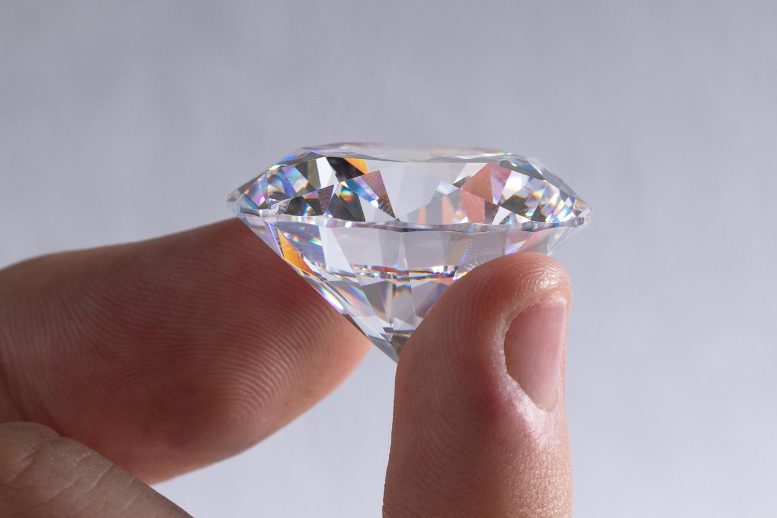
Researchers at the University of Gothenburg created diamondiyne, a new form of carbon, in a thin film where two liquids meet.
Carbon can take different forms, including familiar diamond and graphite, depending on how its atoms are arranged.
In diamondiyne, carbon atoms link through triple bonds to form a porous, three-dimensional network of tetrahedra.
The structure had been proposed in theory about 35 years ago, but scientists had not made it before.
Electron microscopy at Stockholm University confirmed repeating crystal patterns in patches, with a measured volume just 10 nanometers across on each side.
This is the first newer carbon allotrope with a three-dimensional structure, and it was made without the high pressure needed to form diamond.
The team will now study its properties and possible uses.

Researchers at the University of Gothenburg have created diamondiyne, a new porous, three-dimensional form of carbon.
The structure had been proposed theoretically decades ago and is made by joining carbon atoms through triple bonds.
Electron microscopy at Stockholm University confirmed repeating crystal patterns in small patches on the film’s surface.
The researchers produced patterns in a volume measuring 10 nanometers on each side.
The team plans to investigate diamondiyne’s properties and possible uses.
- Who
- Researchers at the University of Gothenburg, led by Karl Börjesson, created diamondiyne.
- What
- They created a porous, three-dimensional carbon allotrope with a crystal structure confirmed in small patches.
- When
- The study was published on 14 September 2026.
- Where
- The material formed in a thin film where two liquids meet. Electron microscopy at Stockholm University confirmed its structure.
- Why
- The team had been working to create porous carbon-based materials without metal ions; the article does not state a specific practical purpose for creating diamondiyne.
This story does not have two clearly opposing sides.
Diamondiyne was proposed as a possible carbon structure.
The study describing diamondiyne was published in Angewandte Chemie International Edition.
- Material
- Diamondiyne, a porous carbon allotrope
- Research institution
- University of Gothenburg
- Structure confirmation
- Electron microscopy at Stockholm University
- Confirmed pattern size
- 10 nanometers on each side
- Publication date
- 14 September 2026
What people are saying
The structure creates voids between the tetrahedra. The carbon allotrope can therefore be compared to a porous diamond. But unlike diamonds, diamondiyne does not require high pressure to make the carbon atoms bond to one another.
It has taken us an incredibly long time, but we finally succeeded. I am very pleased.
We will now investigate the properties of diamondiyne and how it might be used. One exciting aspect of the porous structure is that several diamondiyne structures could potentially be interwoven through each other’s voids.