

Science & Tech · Space · 8 hrs ago
Supercomputers and AI Simulate the Milky Way at Star-Level Detail
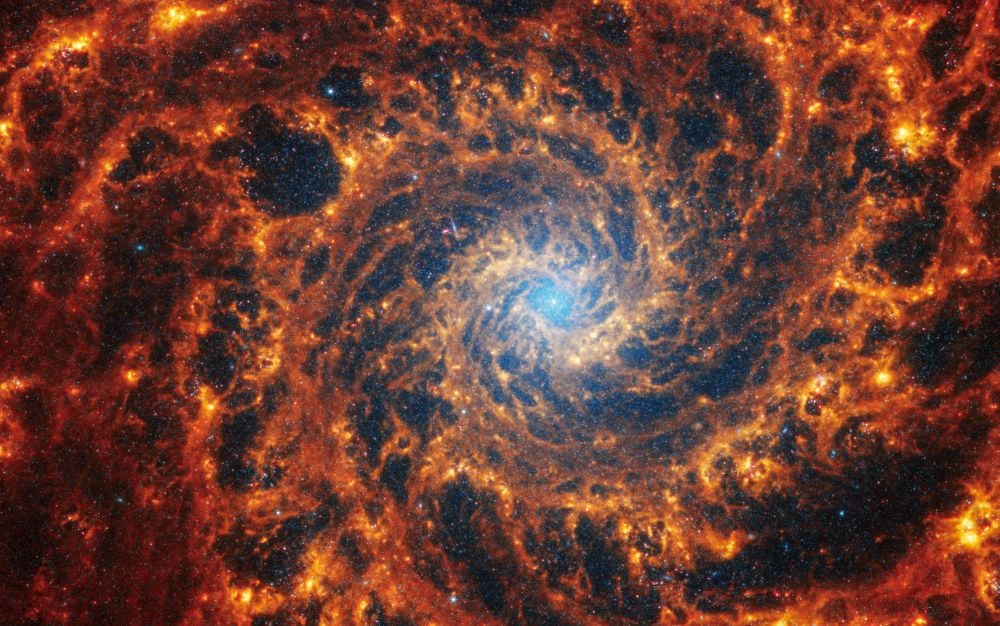
Researchers have simulated the Milky Way at star-level detail using three supercomputers and an AI model.
The work was led by Keiya Hirashima of RIKEN in Japan, with researchers using Aurora, Frontier and JUPITER.
Earlier simulations represented clusters of stars, averaging the behaviour of stars within them; their smallest units had the mass of about 100 Suns.
The new simulation used 5.4 trillion particles, about 10,000 times as many as state-of-the-art simulations.
To reduce computing demands, the team used an AI model called PHEASANT to predict how gas around supernova explosions evolves, allowing the larger simulation to skip many small time steps.
This finer detail could help researchers study how a galaxy’s stars and gas behave, though the simulation’s particles are proxies for stars, not a count of individually tracked real stars.
The researchers expect simulations to improve as computing power grows, but say better resolution still requires work because dense, rapidly changing gas demands shorter time steps.

Researchers used three exascale supercomputers and an AI model to simulate the Milky Way at the level of individual stars.
The highest-resolution simulation used 5.4 trillion particles, about 10,000 times as many as state-of-the-art simulations, the authors wrote.
The work combines Aurora, Frontier and JUPITER, which use different hardware.
The AI model, called PHEASANT, predicts how gas around supernova explosions evolves, reducing the need for small time steps.
The research was presented in a paper for the SC26 international computing conference.
- Who
- Lead author Keiya Hirashima of RIKEN in Japan and a team of researchers.
- What
- They used three supercomputers and an AI model to simulate the Milky Way at individual-star detail.
- When
- The paper was published for SC26; the article was published on November 26, 2026.
- Where
- Not stated.
- Why
- The AI model helped make the simulation more efficient by predicting how gas around supernova explosions evolves.
This story does not have two clearly opposing sides.
This story does not have a timeline yet.
- Simulation particles
- 5.4 trillion in the highest-resolution simulation
- Scale comparison
- About 10,000 times the particles in state-of-the-art simulations, according to the authors
- Supercomputers
- Aurora, Frontier and JUPITER
- AI model
- PHEASANT
- Lead author
- Keiya Hirashima of RIKEN in Japan
What people are saying
We expect better simulations as computational power increases, but this still requires work on improving resolutions, and for a Milky Way-sized galaxy, it’s not straightforward
When we look at smaller regions in detail, we encounter areas where the gas is denser and changes rapidly. This means the simulation needs to take much shorter steps in time, which greatly increases the amount of calculation required.
We overcame this problem by using an AI model to predict how gas around supernova explosions evolves