

Science & Tech · Science & Environment · 33 mins ago
Simulations predict light signatures that could identify defects in boron nitride
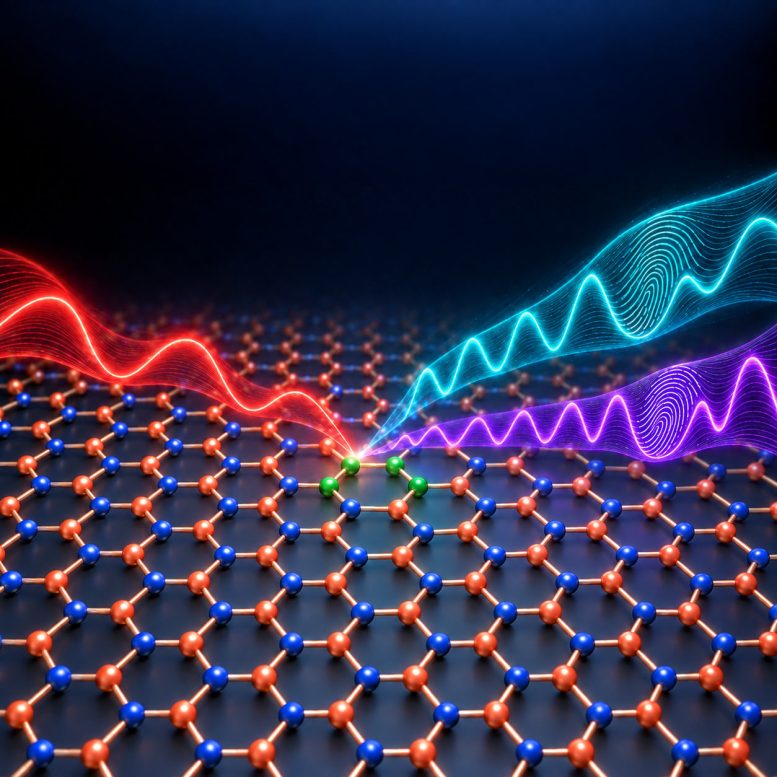
A University at Buffalo-led team predicted optical signatures for 10 defects in hexagonal boron nitride, a material made of boron and nitrogen atoms.
The team used computer simulations to study imperfections such as missing atoms and places where carbon atoms had replaced them.
Different defects were predicted to change laser light in distinct ways, including by producing light at twice or three times the incoming laser’s frequency.
The signal also depended on the light’s polarization, so defects with the same atoms arranged differently could have different signatures.
Comparing measured light with these predictions could help identify defects in material samples, although the findings still need experimental testing.
Some defects can emit single photons, which could carry quantum information or support advanced sensing, so identifying useful ones may help researchers work toward precisely arranged arrays for future quantum technologies.

University at Buffalo-led researchers used computer simulations to predict optical fingerprints for 10 types of defects in hexagonal boron nitride.
The predicted light responses vary with the atoms in a defect, their arrangement and the light’s polarization.
The results could help researchers identify defects by comparing measured light responses with the predictions.
Some defects in the material can emit single photons, which may be useful in future quantum technologies.
- Who
- Researchers led by the University at Buffalo.
- What
- They predicted optical fingerprints for 10 types of defects in hexagonal boron nitride.
- When
- The study was published October 19, 2026.
- Where
- University at Buffalo; the material studied was hexagonal boron nitride.
- Why
- To help identify defects and determine which could be useful sources of quantum light.
This story does not have two clearly opposing sides.
The study was published in Nano Letters.
SciTechDaily published an article describing the research.
- Material
- Hexagonal boron nitride (h-BN)
- Defect types examined
- 10
- Study method
- Computer simulations
- Publication date
- October 19, 2026
- Journal
- Nano Letters
What people are saying
These distinctive light responses could eventually allow us to experimentally identify not only which atoms are involved in a defect, but also precisely how they’re arranged.
Not all atomic defects are created equal. Making it easier to identify defects brings us another step closer to determining which ones have the properties we’re looking for.
The ultimate goal is to create a material where we can precisely control the placement of defects that produce quantum light.