

Science & Tech · Science & Environment · 2 hrs ago
JWST Finds Evidence of a Shell Merger in Cassiopeia A
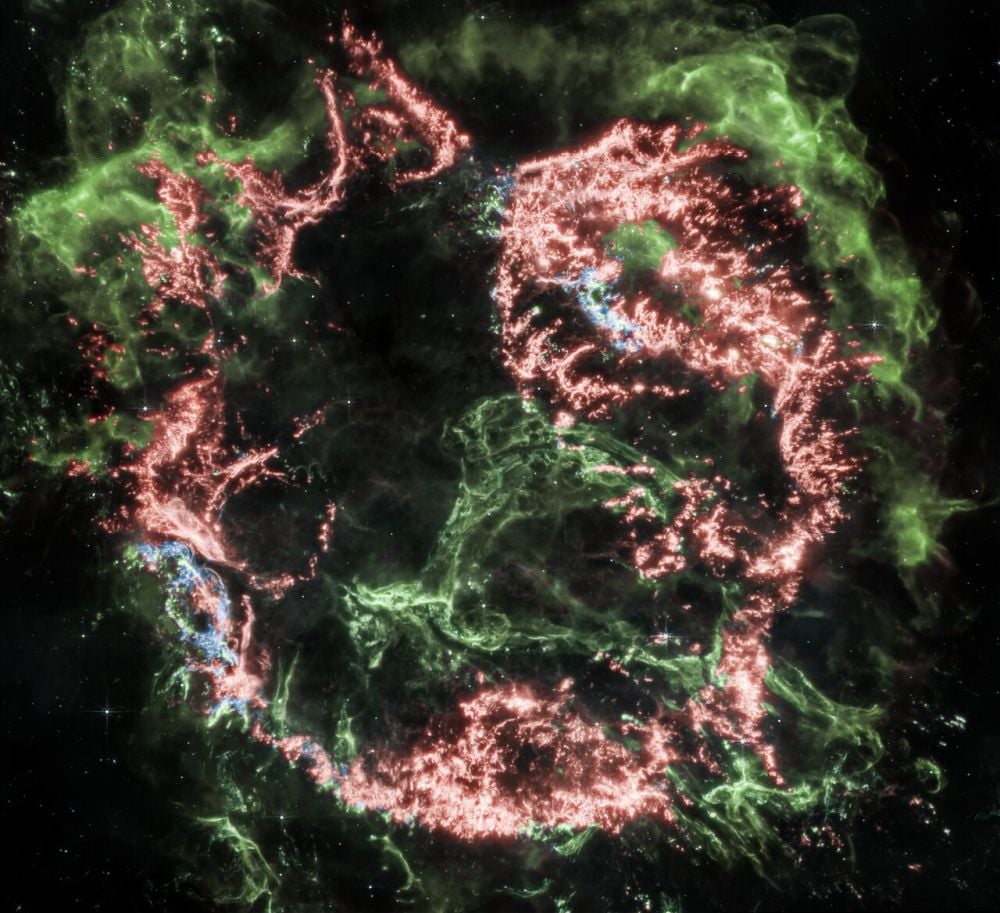
JWST mapped dust in the supernova remnant Cassiopeia A using its mid-infrared instruments.
Cassiopeia A is about 11,000 light-years from Earth, and people observed it around 1667.
The telescope separated dust in individual clumps, allowing researchers to study distinct regions instead of treating the remnant as one mixture.
The dust compositions point to a merger of the star’s layers shortly before it exploded.
Massive stars build elements heavier than hydrogen and helium, then spread them into space when they die.
Those elements help form planets and living things, and the remnant’s contents also give scientists clues about the star’s history.

JWST observations of Cassiopeia A show evidence that the star that exploded to form the remnant underwent a shell merger before the explosion.
Researchers used JWST’s Mid-Infrared Instrument and Medium-resolution Spectrometer to identify dust in individual clumps of the remnant.
The observations allowed the team to study chemically distinct regions instead of treating the material as a mixed whole.
The findings may help astronomers understand the structure of the massive star before it exploded.
Cassiopeia A is about 11,000 light-years away and was observed from Earth around 1667.
- Who
- A research team led by Tea Temim, a research scientist from Columbia University.
- What
- JWST observations of Cassiopeia A’s dust provide evidence that its progenitor star underwent a shell merger.
- When
- The research article was published on 2026-11-23.
- Where
- In the supernova remnant Cassiopeia A, about 11,000 light-years from Earth.
- Why
- The team studied the remnant’s dust to learn about the star that exploded and its history before the explosion.
This story does not have two clearly opposing sides.
Material in the progenitor star’s shells churned and circulated, which can cause the shells to merge.
Cassiopeia A was observed from Earth.
Universe Today published an article about the JWST study.
- Remnant
- Cassiopeia A (Cas A)
- Distance
- About 11,000 light-years from Earth
- Telescope instrument
- JWST’s Mid-Infrared Instrument (MIRI) and Medium-resolution Spectrometer (MRS)
- Lead author
- Tea Temim, a research scientist from Columbia University
- Publication date
- 2026-11-23
What people are saying
Material within these shells churns and circulates, which can cause the shells to merge shortly before the supernova explosion.
The unprecedented spatial resolution at mid-IR wavelengths allows us to isolate dust emission from individual arcsecond-scale clumps of supernova (SN) ejecta and circumstellar material (CSM) and identify the dominant dust species in each chemically distinct region.