

Science & Tech · Science & Environment · 1 hr ago
New imaging method tracks ultrafast events across 100,000-fold time range
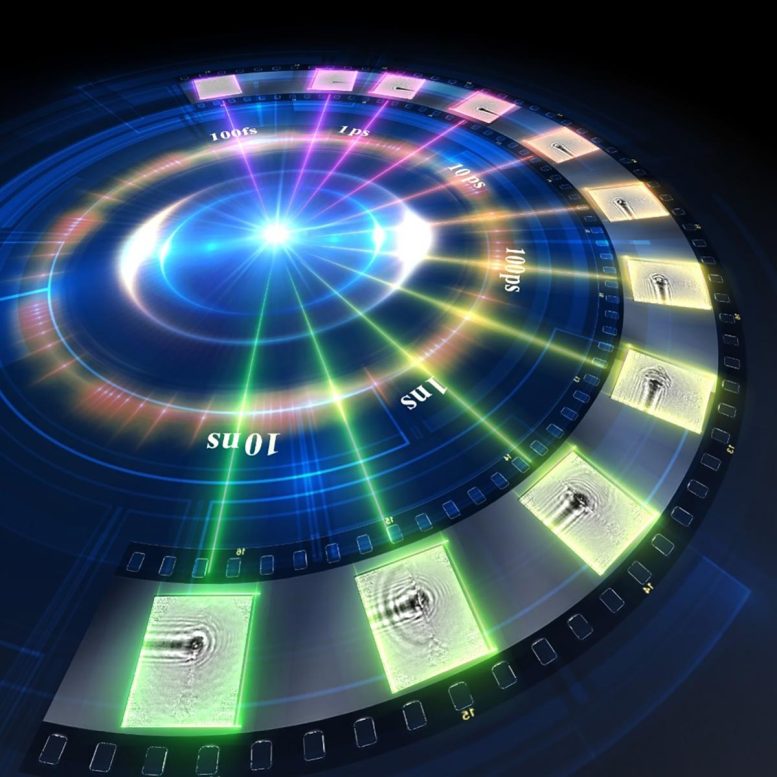
A team at the University of Tokyo developed a new ultrafast imaging method to record events that unfold too quickly for ordinary cameras.
The method, called logarithmic ultrafast photography, places images closer together at first and farther apart later, rather than using equal time gaps.
With 11 frames, it covers a 100,000-fold range in time, from femtoseconds to nanoseconds.
Researchers demonstrated it by recording how glass and hydroxyapatite, a mineral found in bones and teeth, changed after an ultrashort laser pulse.
The images captured early changes and later shock waves and material ejection in the same recording.
This matters because some events are difficult to reproduce exactly, and recording their stages together can show connections that separate experiments might miss.
The technique gives researchers a way to study hard-to-repeat ultrafast processes in one shot; no further plans were stated.

Researchers at the University of Tokyo developed an imaging method that tracks ultrafast events across a 100,000-fold range of time.
Logarithmic ultrafast photography uses 11 frames placed at customized intervals, with more frames concentrated around early changes.
The method captures events from femtoseconds to nanoseconds in a single recording.
Tests showed how glass and hydroxyapatite respond to an ultrashort laser pulse, including later shock waves and material ejection.
The researchers say the approach could help study phenomena that are difficult to reproduce exactly.
- Who
- A team led by Keiichi Nakagawa at the University of Tokyo developed the method.
- What
- They developed logarithmic ultrafast photography, which uses 11 images at customized time intervals to capture an event across a broad range.
- When
- The article was published on 2026-11-16.
- Where
- The University of Tokyo.
- Why
- To connect the early and later stages of ultrafast events in one measurement, including phenomena that are difficult to reproduce.
This story does not have two clearly opposing sides.
This story does not have a timeline yet.
- Frame count
- 11 images
- Time range
- Approximately five orders of magnitude, or 100,000-fold
- Time scales
- Femtoseconds to nanoseconds
- Imaging technique
- Sequentially timed all-optical mapping photography (STAMP)
- Timing method
- Band-resolved individual delay generation (BRIDGE)
What people are saying
We wanted to find a way to connect these very different timescales in a single measurement. In other words, we wanted to see both the first instance and what follows, without having to choose one or the other.
We are particularly interested in phenomena that are difficult to reproduce exactly. In those cases, recording the early and later stages of the same event can reveal relationships that might be lost when a sequence is reconstructed from separate experiments.