

Science & Tech · Science & Environment · 6 hrs ago
Soft-armed drone folds on contact to pass through narrow gaps
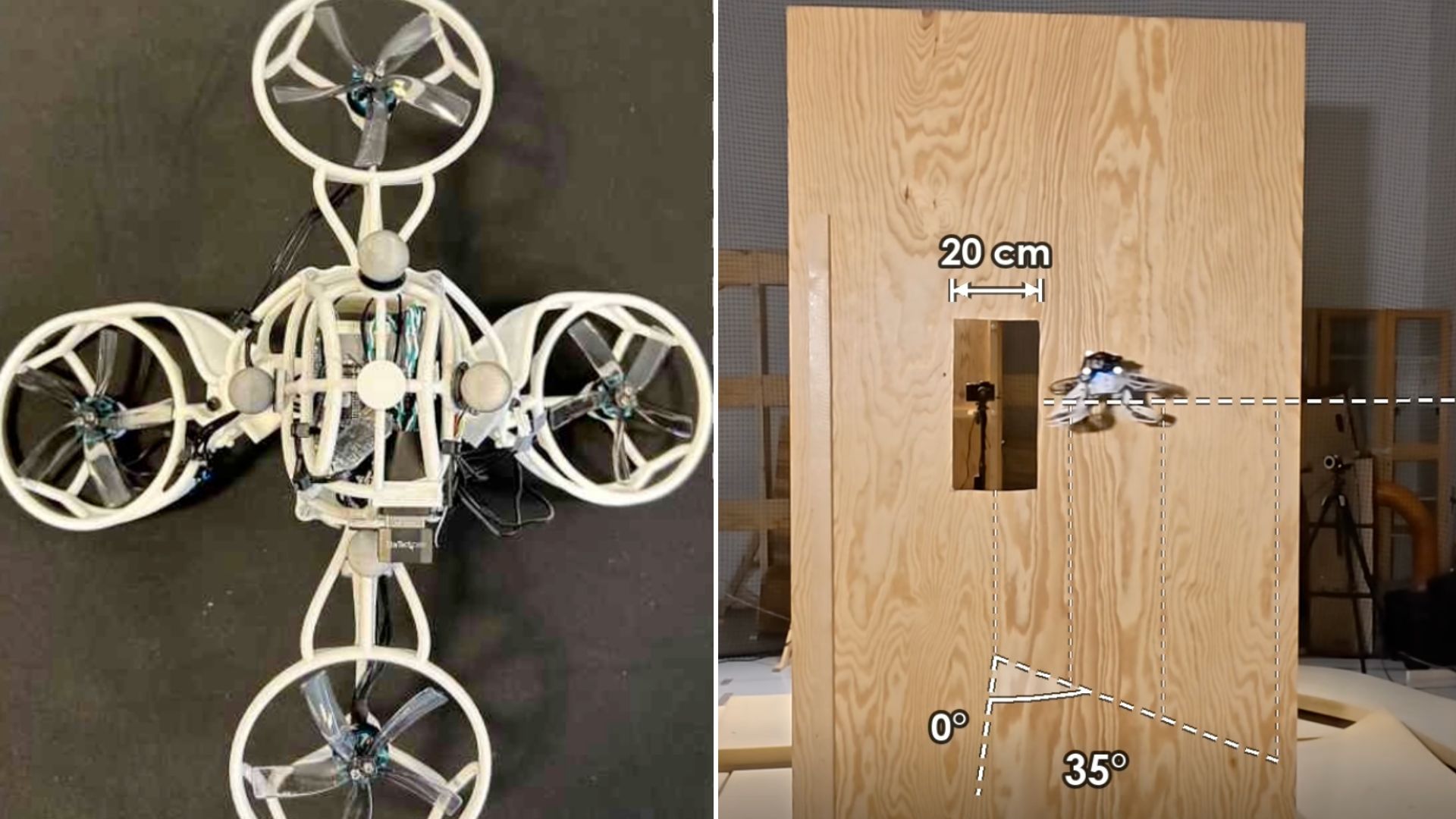
Researchers at NTNU and ETH Zurich built a quadrotor with two spring-loaded arms that fold when they hit an obstacle.
The arms use elastic joints, so the drone does not need motors to fold them.
It narrows from 12.3 inches to 5.6 inches when pressed against an obstacle, allowing it to pass through gaps 52% narrower than its normal width.
In a test, it flew through a 5.9-by-7.9-inch opening at 4.5 mph and also passed through a narrow cylindrical tube.
The drone added only 2 millimeters of position error and used less than 1% extra electrical power in open flight compared with an identical rigid drone.
The design could help drones enter tight spaces such as collapsed buildings, industrial piping and ventilation shafts, though impacts at some approach angles caused an arm to dislocate.

Researchers at NTNU and ETH Zurich developed a quadrotor with spring-loaded soft arms that fold on contact, helping it pass through narrow openings.
The arms fold passively using elastic rolling cam joints, without folding motors.
The prototype narrows from 12.3 inches to 5.6 inches and cleared an opening 52 percent narrower than its normal span.
In a flight test, it passed through a 5.9-by-7.9-inch opening at 4.5 mph.
Compared with an identical rigid drone, it added 2 millimeters of position error and used less than 1 percent more electrical power in open flight.
- Who
- Researchers at NTNU’s Autonomous Robots Lab and ETH Zurich.
- What
- They developed and tested a quadrotor with passive soft arms that fold on contact.
- When
- The article was published on November 22, 2026. The testing date is not stated.
- Where
- The research involved NTNU and ETH Zurich; the prototype was demonstrated in lab tests.
- Why
- To help drones pass through tight spaces without folding motors, extra wiring or batteries.
This story does not have two clearly opposing sides.
This story does not have a timeline yet.
- Research teams
- NTNU’s Autonomous Robots Lab and ETH Zurich
- Normal width
- 12.3 inches (31.3 centimeters)
- Collapsed width
- 5.6 inches (14.1 centimeters)
- Test opening
- 5.9 by 7.9 inches (15 by 20 centimeters)
- Test speed
- 4.5 mph (2 meters per second)
- Power penalty in open flight
- Less than 1 percent compared with an identical rigid drone