

Science & Tech · Science & Environment · 8 hrs ago
Sheffield scientists reproduce the Lycurgus Cup’s colour-changing glass
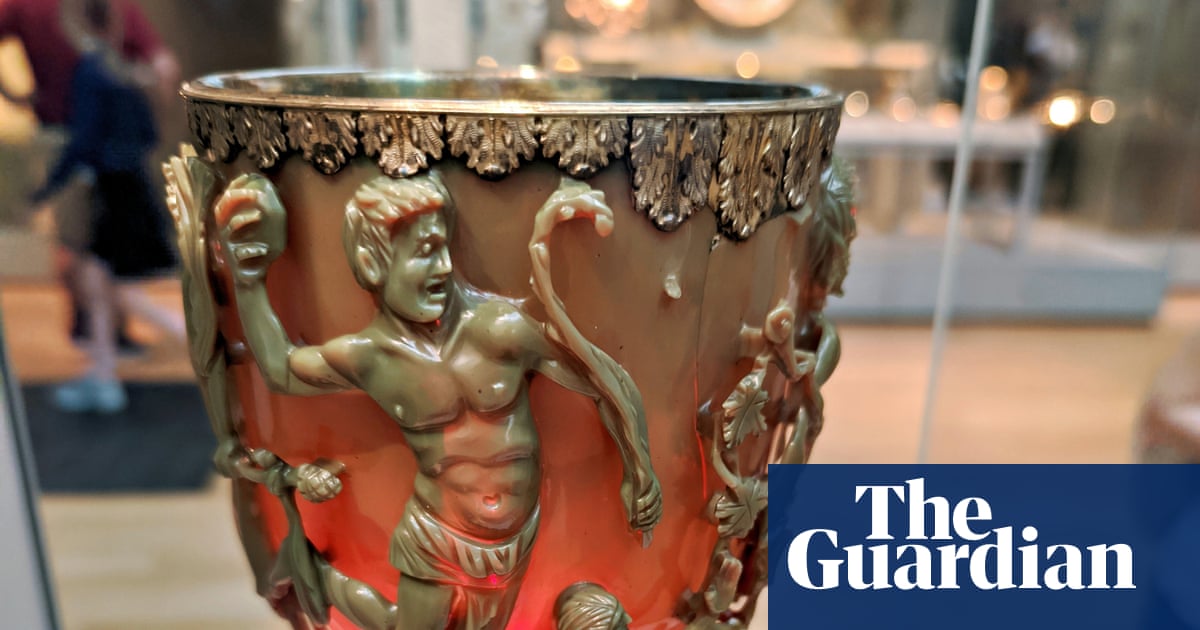
Scientists at the University of Sheffield reproduced the Lycurgus Cup’s colour-changing effect using a repeatable glass-making recipe.
The fourth-century Roman cup shifts from green to red depending on how light reaches it.
Earlier research found tiny gold-and-silver particles in fragments of the cup, but making glass with a similar effect had proved difficult.
In the Sheffield recipe, gold and silver nanoparticles block blue and green light, allowing red and orange light through, while reflected light is scattered to create the green appearance.
The work offers a closer look at Roman glassmakers’ skills and how carefully they had to control the furnace conditions.
A modern sculpture inspired by the cup will be shown in Sheffield from 6 to 15 November, then placed on permanent display at the Turner Museum of Glass.

Scientists at the University of Sheffield have reproduced the colour-changing effect of the fourth-century Roman Lycurgus Cup.
The glass shifts from jade green in normal light to ruby red when lit from behind.
The team used gold and silver nanoparticles in glass, following a recipe derived from a fragment of the original.
The project aims to help explain how Roman glassmakers achieved the effect.
A contemporary sculpture showing the effect is due to be displayed in Sheffield in November.
- Who
- Scientists at the University of Sheffield, including glass specialist Lisa Hollands, reproduced the effect.
- What
- They made glass that changes colour from green to red depending on the light.
- When
- The results were reported in October 2026. The original cup dates to the fourth century.
- Where
- The research was conducted at the University of Sheffield in the UK.
- Why
- The project began as a public outreach request and developed into research that could help explain Roman glassmaking.
This story does not have two clearly opposing sides.
Roman makers created the Lycurgus Cup.
The cup was recognised as one of the seven glass wonders of the world by an international panel.
The University of Sheffield reported that its scientists had reproduced the cup’s colour-changing effect.
A contemporary glass sculpture featuring the effect is due to be shown at the Millennium Gallery during the university’s Festival of the Mind.
- Original cup
- Fourth century
- Original cup location
- British Museum
- Researchers
- University of Sheffield
- Nanoparticles
- Gold and silver
- Sculpture exhibition
- Millennium Gallery, 6–15 November 2026
3 sources
What people are saying
To me, it’s magic.
I accepted the challenge knowing that it might not work, as I knew it wasn’t as simple as embedding nanoparticles off the shelf into a glass
This is more ambitious and more precise
For me, it’s a connection with the Roman makers