

Health · Medical Research · 2 hrs ago
Twins with Parkinson’s had lower 10-year survival than unaffected siblings
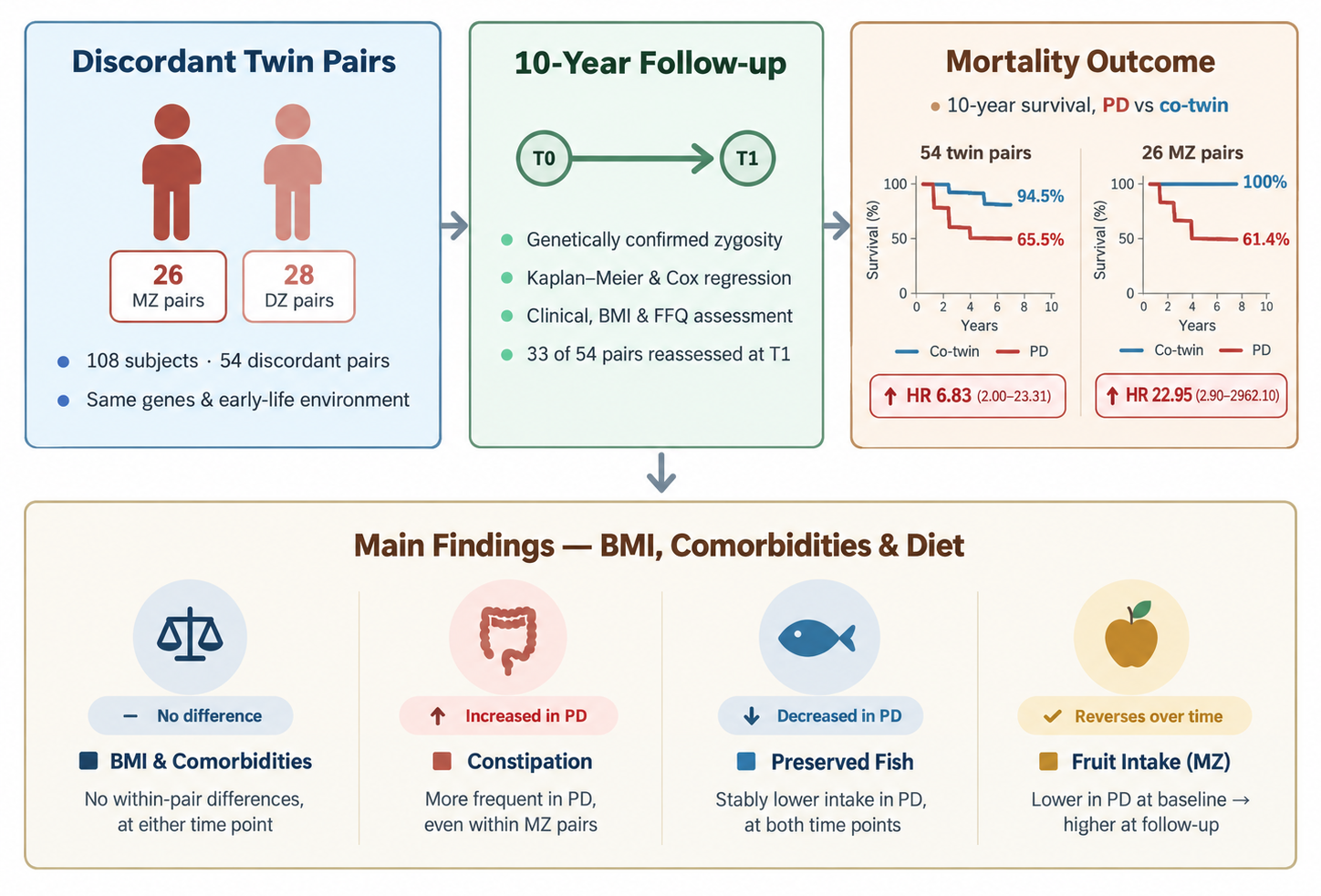
Researchers in Italy followed 54 twin pairs with different Parkinson’s diagnoses for 10 years to examine health, lifestyle and survival.
The study included 108 people, with an average age of 66; in each pair, one twin had Parkinson’s and the other had no neurodegenerative disease.
Seventeen twins with Parkinson’s died, compared with three of their unaffected co-twins, equal to 31.5% and 5.6% of each group.
Survival rates diverged between the affected twins and their co-twins over time, with a larger difference among identical twins.
The researchers said the difference in identical twins was uncertain because the number of deaths was small.
The findings show an association in this group, but the study does not establish why survival differed or whether Parkinson’s alone caused the difference.

A 10-year follow-up study found that twins with Parkinson’s disease had lower survival than their unaffected co-twins.
Among 54 twin pairs recruited in Italy, 17 of 54 twins with Parkinson’s died, compared with three of 54 unaffected co-twins.
The study included 26 identical and 28 fraternal twin pairs, for a total of 108 participants.
Survival differences were more pronounced among identical twins, but researchers said the small number of deaths made the size of that difference uncertain.
The study also tracked lifestyle, clinical features, nutritional status and dietary habits.
- Who
- Researchers studied 54 twin pairs in which one twin had Parkinson’s disease and the other did not.
- What
- The 10-year follow-up found lower survival among twins with Parkinson’s than among their unaffected co-twins.
- When
- Over a 10-year follow-up. The study’s publication date was October 29, 2026.
- Where
- The twins were recruited in Italy.
- Why
- The study examined mortality and how clinical features, lifestyle, nutrition and dietary habits changed over time. It used twin pairs to study Parkinson’s disease in people with shared genes and environments.
This story does not have two clearly opposing sides.
Researchers collected information on participants’ lifestyle, clinical features and dietary habits.
Researchers determined survival status, updated participant information by telephone and reassessed twin pairs.
- Twin pairs
- 54 pairs: 26 identical and 28 fraternal
- Participants
- 108 total; average age 66
- Deaths with Parkinson’s
- 17, or 31.5% of affected twins
- Deaths among unaffected co-twins
- 3, or 5.6%
- Follow-up
- 10 years
- Location
- Italy