

Business · Economy · 8 hrs ago
Indonesia’s Growth Tops 5%, but Many Households Still Feel Squeezed
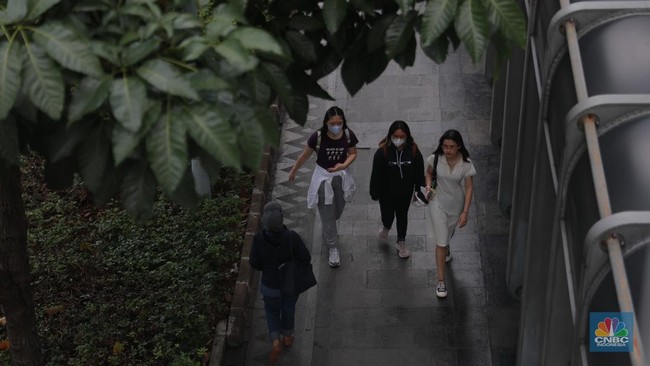
Indonesia’s economy is growing by more than 5%, but many people say rising prices are making life harder.
Economist Raden Pardede says 143 million people are near the middle class: they earn too much to qualify for social assistance but not enough to live comfortably.
He argues that growth is not creating enough formal jobs or raising incomes faster than inflation.
In August 2026, informal workers outnumbered formal workers, at 85.73 million compared with 62.25 million, while average employee pay was Rp3.42 million.
The middle class also shrank by nearly 10 million people between 2019 and 2024, according to Deputy Coordinating Minister for Economic Affairs Dradjad H. Wibowo.
Dradjad said this change reflects shifting work and income patterns, including technology, artificial intelligence and geopolitical changes, not only weaker buying power.
Improving the quality of growth remains a challenge, while the sources give no specific next step.

Indonesia’s economy is growing above 5%, but economist Raden Pardede says the quality of growth has not ensured enough formal jobs or income growth above inflation.
He said 143 million people are moving toward the middle class but do not qualify for social assistance and still struggle to meet their needs.
Informal work accounted for 85.73 million employed people in August 2026, compared with 62.25 million in formal work.
Deputy Coordinating Minister for Economic Affairs Dradjad H. Wibowo said the shrinking middle class should not be seen only as a loss of purchasing power, pointing to economic transformation and changing jobs.
The number of Indonesians in the middle class fell from more than 57 million in 2019 to 47.85 million in 2024.
- Who
- Economist Raden Pardede and Deputy Coordinating Minister for Economic Affairs Dradjad H. Wibowo.
- What
- They discussed economic growth above 5%, household financial strain and the shrinking middle class. They offered different explanations for the pressures.
- When
- Pardede’s comments were reported on November 9, 2026. Wibowo spoke on November 5, 2026.
- Where
- Indonesia.
- Why
- Pardede said growth has not generated enough formal jobs or income gains above inflation. Wibowo cited economic transformation, technology, artificial intelligence and geopolitical change.
Raden Pardede
Dradjad H. Wibowo
Meaning of the shrinking middle class
Raden Pardede
Pardede said many people moving toward the middle class are not receiving social assistance but still cannot afford a sufficient standard of living.
Dradjad H. Wibowo
Wibowo said the decline in the middle-class population cannot be explained solely as falling purchasing power.
Economic conditions
Raden Pardede
Pardede said growth quality needs improvement because formal job creation and income growth have not kept pace with inflation.
Dradjad H. Wibowo
Wibowo pointed to economic transformation, technology, artificial intelligence and geopolitical change reshaping jobs and income sources.
Indonesia had more than 57 million people in the middle class, about 21.5% of the population, according to figures cited by Dradjad.
The middle-class population fell to 47.85 million, about 17% of the population.
Indonesia had 85.73 million people in informal work and 62.25 million in formal work.
Dradjad discussed the changing size and composition of the middle class in an interview with CNBC Indonesia.
CNBC Indonesia reported Pardede’s comments on growth, job quality and households moving toward the middle class.
- Economic growth
- Above 5%
- People moving toward the middle class
- 143 million
- Middle-class population in 2019
- More than 57 million; about 21.5% of the population
- Middle-class population in 2024
- 47.85 million; about 17% of the population
- Informal employment, August 2026
- 85.73 million people
- Average employee wage, August 2026
- Rp3.42 million
What people are saying
The number is now 143 million, they are called those moving toward the middle class. Our people moving toward the middle class do not receive social assistance, but they are also not a middle class that can meet their needs.
So this is a quality problem. On the macro level it is still good, but the quality may need to be improved.
This is indeed an economic transformation. There is technological disruption, there is AI, there is geopolitics.