

Science & Tech · Science & Environment · 2 hrs ago
Century-old fossil reveals a new dinosaur species on the Isle of Wight
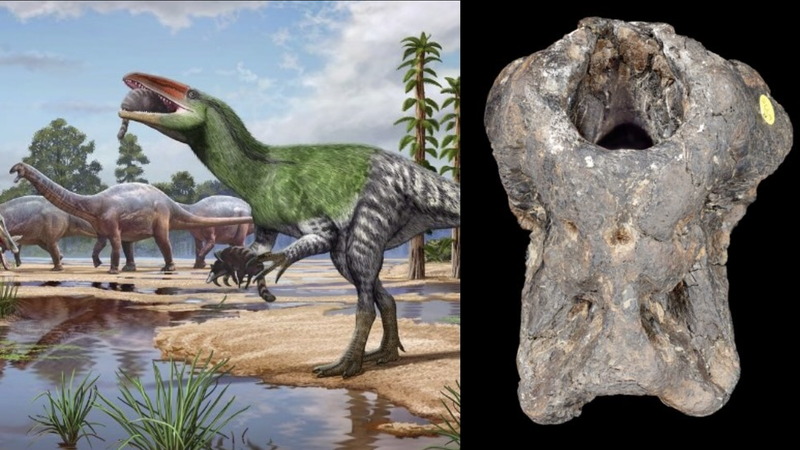
Researchers identified a new dinosaur species from a fossil found on England’s Isle of Wight more than a century ago.
The fossil reached London’s Natural History Museum in 1924 and remained in storage until paleontologists Cassius Morrison and Charlie Scherer examined it using CT scans and 3D modeling.
They named the species Invictibellatrix amberina, and their study was published in Royal Society Open Science on October 14, 2026.
It lived about 120 million years ago and was the first megaraptoran identified in Europe.
Unlike some members of its group, which could be as large as a T. rex, it was about human height and likely ate meat.
A distinctive crest on its skull helped researchers classify it as a new species; they also believe it likely had feathers and used large claws to catch prey.
The discovery shows that old museum fossils can still reveal new species, and researchers say other Isle of Wight finds may also be waiting to be studied.

Researchers identified a new dinosaur species from a fossil that had been stored at the Natural History Museum in London for about a century.
The species, named Invictibellatrix amberina, is the first megaraptoran known to have been discovered in Europe.
The fossil was found on the Isle of Wight, off the south coast of England.
Researchers used CT scanning and 3D modeling to study the specimen.
Their peer-reviewed study was published in Royal Society Open Science on October 14, 2026.
- Who
- Paleontologists Cassius Morrison and Charlie Scherer of University College London studied the fossil.
- What
- They identified a new dinosaur species, Invictibellatrix amberina, from a long-stored fossil.
- When
- The fossil entered the Natural History Museum in 1924. The study was published on October 14, 2026.
- Where
- The fossil was found on the Isle of Wight and studied at the Natural History Museum in London.
- Why
- The researchers reevaluated the specimen using modern techniques; its distinctive skull crest helped identify it as a new species.
This story does not have two clearly opposing sides.
Amateur paleontologist Reginald Walter Tooley found the fossil on the Isle of Wight.
After Tooley’s death, the fossil came to the Natural History Museum in London.
Cassius Morrison and Charlie Scherer took the fossil from storage and studied it using modern techniques.
The researchers published their study in Royal Society Open Science.
- Species
- Invictibellatrix amberina
- Fossil location
- Isle of Wight, off the south coast of England
- Museum arrival
- 1924
- Researchers
- Cassius Morrison and Charlie Scherer, University College London
- Estimated height
- About 5 feet (1.5 meters)
- Publication
- Royal Society Open Science, October 14, 2026
What people are saying
It’s a real mystery that this fossil was overlooked for so long, sitting in a drawer for nearly 100 years.