

Health · Medical Research · 1 hr ago
Experimental Nasal Spray Protects Memory in Alzheimer’s Models
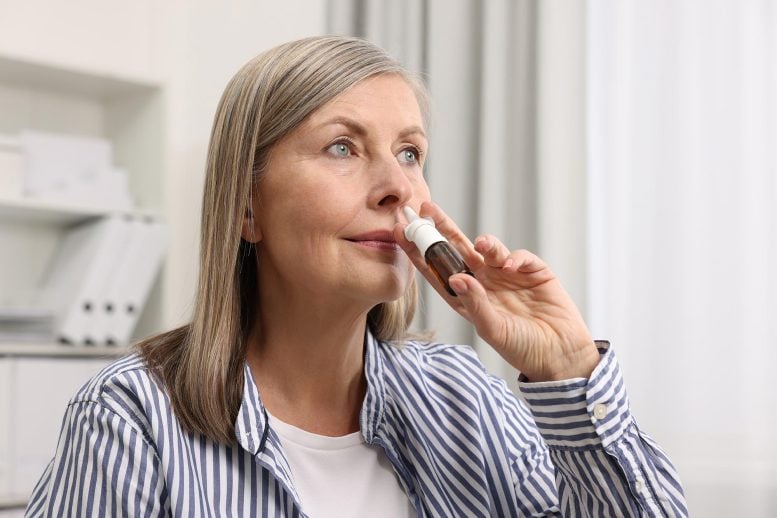
Researchers tested a nasal spray made with tiny particles released by cells in animal models of Alzheimer’s disease.
The particles came from cells in the amniotic membrane, the tissue around a developing fetus.
In the animals, the particles reached the hippocampus, a brain region important for memory, and entered nerve cells and microglia, which help defend the brain.
The treatment reduced brain inflammation and protected connections between nerve cells, while improving cognitive abilities.
It prevented memory problems and also countered decline after it had begun in the animal models.
The particles also protected human neurons grown in the laboratory from cells made using samples from people with Alzheimer’s and healthy individuals.
The findings are preliminary, and the spray is not an available treatment; researchers say it needs further testing in people.

Researchers developed an experimental nasal spray that protected brain-cell connections and improved memory in animal models of Alzheimer’s disease.
The spray contains extracellular vesicles from cells of the amniotic membrane, which reached the hippocampus when given through the nose.
The treatment reduced neuroinflammation and protected neuronal function, including at synapses.
The vesicles also showed protective effects in human neurons grown in the laboratory from patient and healthy-donor cells.
Researchers said the findings are preclinical and require further validation in humans; the spray is not an available Alzheimer’s therapy.
- Who
- Researchers at Università Cattolica del Sacro Cuore, Fondazione Policlinico Universitario A. Gemelli IRCCS and the E. Menni Research Center of Fondazione Poliambulanza.
- What
- They tested an experimental nasal spray containing amniotic-membrane extracellular vesicles. It protected brain connections and improved memory in animal models.
- When
- Not stated
- Where
- The research involved animal models and human neurons grown in the laboratory. The institutions are in Italy.
- Why
- The researchers investigated whether the vesicles could counter neuroinflammation and protect neuronal function and memory.
This story does not have two clearly opposing sides.
This story does not have a timeline yet.
- Treatment
- Nasal spray containing extracellular vesicles from amniotic membrane cells
- Brain region reached
- Hippocampus
- Animal-model findings
- Prevented memory deficits and countered cognitive decline after it had begun
- Human-cell model
- Neurons generated from stem cells derived from skin biopsies of Alzheimer’s patients and healthy individuals
- Research publication
- Translational Neurodegeneration
What people are saying
The study suggests the need to direct research into Alzheimer’s therapies by focusing not only on counteracting the accumulation of toxic compounds like beta-amyloid and tau, but also by paying close attention to the cellular environment in which neurons live (e.g., microglia and astrocytes) and the molecular signals (e.g., cytokines or microRNAs) exchanged by these cells, which can influence synapse function.
These are preclinical results that require further validation in humans and do not yet represent an available therapy for Alzheimer’s disease, but they point to a very promising direction: understanding whether some of the mechanisms through which the placenta naturally regulates inflammation and protects tissues …