

Science & Tech · Space · 9 hrs ago
Hera reveals a rocky, cratered side of asteroid Didymos
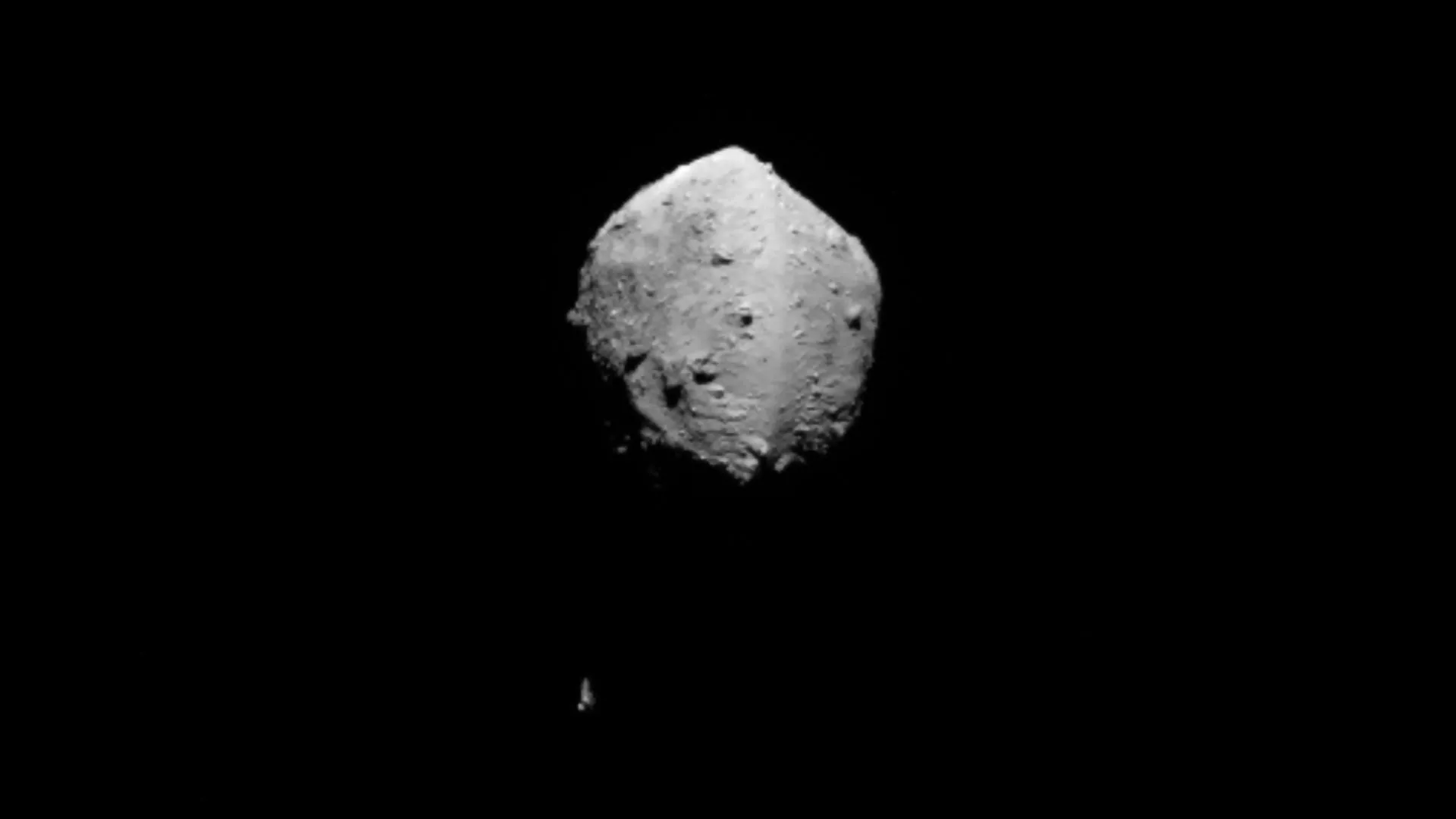
The European Space Agency’s Hera spacecraft has sent back a close-up view of Didymos, part of a two-asteroid system.
The image shows boulders, craters and unusual grooves or ridges on Didymos, the larger asteroid, while its smaller companion Dimorphos is mostly in shadow.
In 2022, NASA deliberately crashed its DART spacecraft into Dimorphos, shortening its orbit around Didymos by about 33 minutes.
Scientists think debris from that impact may have crossed the roughly one kilometre between the asteroids and reached Didymos, but they do not yet know whether it caused any of the features in the image.
Hera will examine both asteroids to learn how the impact changed their surfaces and what the bodies are like.
That information could help scientists predict how well a deliberate impact might deflect a dangerous asteroid.
Hera is expected to collect data for six months, and further images and findings were due to be presented on November 25.

The European Space Agency’s Hera spacecraft has sent back close-up images showing boulders, craters and ridge-like features on the asteroid Didymos.
The images show a side of Didymos not previously seen in such detail.
Hera is investigating the effects of NASA’s 2022 DART collision with Dimorphos, Didymos’s smaller companion.
Scientists say debris from that impact may have crossed the roughly 1 km between the asteroids and reached Didymos.
The findings may help researchers understand how asteroid deflection works and improve preparations to protect Earth.
- Who
- The European Space Agency’s Hera mission and the scientists studying the Didymos asteroid system.
- What
- Hera has captured close-up images revealing boulders, craters and other surface features on Didymos.
- When
- The images were reported in November 2026. NASA’s DART spacecraft struck Dimorphos on September 26, 2022.
- Where
- In the Didymos asteroid system, which the articles place about 196.8 million km from Earth.
- Why
- Hera is examining the effects of the DART impact and how asteroid deflection works.
This story does not have two clearly opposing sides.
NASA’s DART spacecraft struck Dimorphos, measurably changing its orbit around Didymos.
Hera reached the Didymos system and sent back its first close-up images.
Further images and findings were due to be presented, according to the German articles.
- Didymos diameter
- 780 m
- Dimorphos diameter
- 151 m
- Distance between asteroids
- Approximately 1 km
- DART impact speed
- Approximately 6.1 km/s
- Change in Dimorphos’s orbital period
- About 33 minutes shorter
7 sources
A Space Probe Returns to Asteroids Where NASA Tested Planetary Defense Systems
NASA Smashed Into an Asteroid. Now ESA’s Hera Spacecraft Is About to Reveal the Damage
ESA's Hera Probe Uses "Superhuman" Vision to Inspect NASA's Asteroid Crash Site
Forscher sind "Feuer und Flamme": Erste Bilder nach Sonden-Kollision auf Asteroiden
Nach zwei Jahren Flug am Ziel: Was brachte der Einschlag? Mission „Hera“ liefert Bilder
NASA smashed into an asteroid. Now Hera has revealed a strange new world
What people are saying
The first thing we said was wow!
This is the other side of Didymos from the one that DART's camera showed us shortly before impact, so this feels like looking at a whole new world.
Since we expect a lot of impact-ejected material to have made it across the approximately 1 km of space from Dimorphos to Didymos, it may be that some of these characteristics originate from this transport of material, and we have exciting work ahead of us to sort it out.
What one sees in the first days is quite promising; the scientists are fired up.